

4G/5G failover for branch offices
A branch office needs its loan or policy system, billing and calls to keep working when the broadband line drops. An Instaroute router at each branch runs broadband and 4G or 5G side by side: health checks move traffic to the cellular path when the line fails, or load balance across both, and dual-SIM arbitration picks the better operator by signal, latency or data usage. Every branch comes online zero-touch and is managed from Instaroute SDWAN Lite 2.0.
By Pradeep Tomar, Founder and CEO. Published , last reviewed .At a glance
- Industry
- NBFCs, insurers, service and sales offices
- Sites
- Branches, sales and service offices
- Links
- Broadband or fibre plus 4G or 5G
- Routers
- IR11004GDW, IRX100-5G, IR11004GSW
How does the network connect?
Site equipment connects to an Instaroute IR11004GDW, which carries the traffic over Broadband or fibre and 4G/5G backup inside a quantum-safe tunnel to Head office and DC and Cloud and SaaS apps. Nothing on site accepts inbound connections.
What problem does it solve?
Most branches in a growing network run on one broadband line from a local provider. When it drops, the branch cannot log in to the loan or policy system, post a bill or take a call, and staff wait for the provider while customers wait for staff.
Cloud applications and calls now carry the working day. A spare dongle only helps once someone notices the line is down and plugs it in, and nobody at head office can see which branch is struggling.
Each new branch also needs a router configured, a firewall set up and someone on site to do it, which slows every opening.
How does Nexapp solve it?
4G/5G failover routers for NBFC, insurance, service and sales branch offices: dual-SIM backup, link load balancing and zero-touch rollout from one console.
Cellular takes over when the line drops
Any port can be a WAN. Health checks watch the broadband link, and the router switches traffic to 4G or 5G when it fails, or load balances across both links while both are up.
Two operators, one box
Dual-SIM arbitration chooses between operators by signal, latency or data usage. Dual-module models such as the IR11004GDW and the two-module IRX100-5Gv2 keep two cellular links active at once, so there is no wait for a SIM switch.
Branch systems kept apart
VLANs and the zone firewall separate branch PCs, IP phones and guest Wi-Fi, and traffic to head office travels in IPsec IKEv2 tunnels with hybrid post-quantum key exchange.
Branches open on day one
Routers are registered by serial number and pull their full configuration at power-on, over cellular if the wired line is not ready yet.
One console for every site
Instaroute SDWAN Lite 2.0 shows the health, signal and data usage of every router, with zero-touch set-up and canary firmware rollout, for up to 100,000 devices per deployment. Run it Nexapp-hosted in India or self-hosted.
How is the site secured in the AI era?
Security is a requirement, not an add-on. AI helps attackers find exposed devices and weak access faster than ever, so this design exposes nothing, encrypts every link and checks every person who connects.
Nothing exposed to the internet
The router opens only outbound, encrypted connections. Equipment on site has no public IP and accepts no inbound connections, so automated scanners have nothing to find. Zero trust access
Quantum-safe encryption on every link
Traffic travels in IPsec IKEv2 tunnels with hybrid ML-KEM key exchange, so data captured today cannot be decrypted later. Post-quantum cryptography
Zones, not one flat network
Each group of equipment on site gets its own zone behind the zone firewall, so one compromised device cannot reach the rest. IoT and OT security
Access for people, not networks
Engineers and vendors connect through InstaAccess to the named equipment they support, and every session is logged. SSE and ZTNA
Signed, staged firmware
Instaroute SDWAN Lite 2.0 rolls out post-quantum-signed firmware to a canary group first, with rollback, so a bad update never reaches every site at once. Instaroute SDWAN Lite 2.0
AI that waits for your approval
NexParth AI spots problems and proposes the fix, and nothing changes until a person approves it. NexParth AI
What does the SDWAN Lite dashboard show?
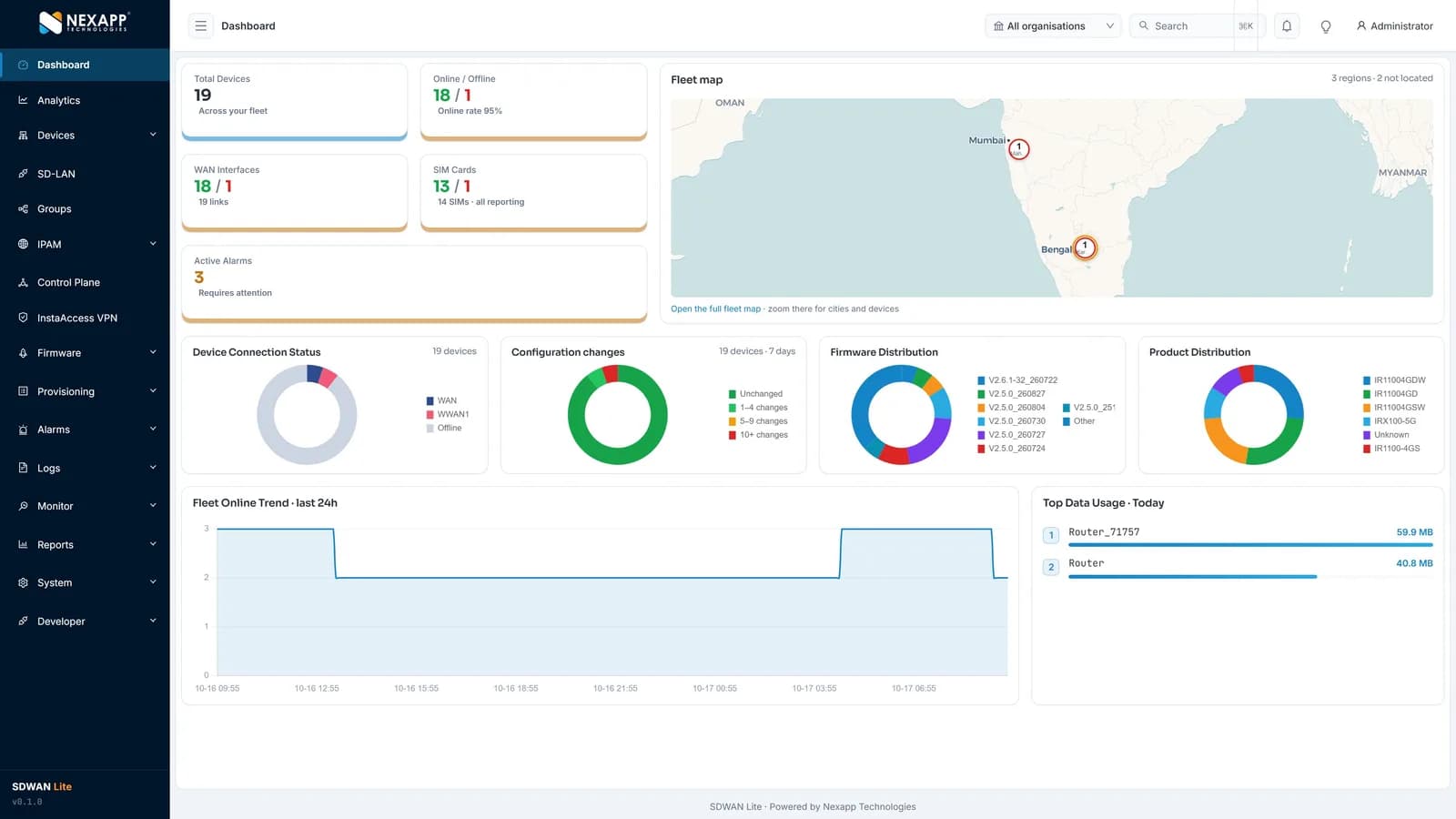
One screen shows the whole fleet: total devices and online rate, WAN links and SIM cards, active alarms, a fleet map, firmware versions, configuration changes, product mix and data usage. Instaroute SDWAN Lite 2.0 manages up to 100,000 routers per deployment, hosted by Nexapp in India or self-hosted.
How is it deployed?
A typical rollout takes 5 steps, and routers configure themselves when they are powered on at site.
Survey the branches
List each branch's broadband provider and check 4G or 5G signal for at least one operator, or two where the branch needs both.
Set one template
Define WAN, SIM policy, VLANs, firewall and Wi-Fi settings once in SDWAN Lite 2.0 for every branch.
Install and power on
The router is registered by serial number and pulls its configuration over whichever link is live first.
Move branches in phases
Branches move one at a time while existing links keep carrying traffic.
Operate
Head office or the 24×7 NOC in Pune watches link health, signal and alarms for every branch.
What does the specification ask for, and how does Nexapp meet it?
These are the requirements buyers and tenders usually set for this application, and the Nexapp capability that meets each one today.
| Requirement | How Nexapp meets it |
|---|---|
| Branch stays up when broadband fails | Link backup, switch and load balance with health checks across broadband and 4G/5G |
| Two operators at critical branches | Dual-SIM arbitration by signal, latency or data usage; two modules on the IR11004GDW and IRX100-5Gv2 |
| Staff, phones and guests kept apart | VLANs and zone firewall; guest SSID with per-SSID isolation |
| Encrypted branch traffic | IPsec IKEv2 with hybrid ML-KEM key exchange |
| Central management | Instaroute SDWAN Lite 2.0 with zero-touch provisioning, alarms and canary firmware rollout |
Which Instaroute router should you use?
For most sites, use the IR11004GDW. Dual-module 4G that keeps two operators live at once alongside broadband, with link backup and load balancing.
IR11004GDW
Dual-module 4G that keeps two operators live at once alongside broadband, with link backup and load balancing.
- Cellular
- 4G LTE Cat 4 or Cat 6
- SIM slots
- 2
- RS232 / RS485
- RS232 and RS485
- Mounting
- Desktop or wall
IRX100-5G
5G SA/NSA with dual SIM, Gigabit ports and Wi-Fi 6 for busy branches.
- Cellular
- 5G SA/NSA, sub-6 GHz
- SIM slots
- 2
- RS232 / RS485
- RS232 and RS485 (up to 3 ports)
- Mounting
- Desktop or wall
IR11004GSW
Single-SIM 4G with five ports and Wi-Fi for small sales offices.
- Cellular
- 4G LTE Cat 4 or Cat 6
- SIM slots
- 1
- RS232 / RS485
- RS232 and RS485
- Mounting
- Desktop or wall
Also used: Instaroute SDWAN Lite 2.0 · Enterprise Wi-Fi
What are the benefits?
- Branches keep working through a broadband outage, on 4G or 5G.
- Two operators back each other up on dual-SIM and dual-module models.
- Branch PCs, phones and guest Wi-Fi sit in separate firewall zones.
- New branches come online zero-touch, before the wired line arrives.
- Head office sees link health, signal and data usage for every branch in one console.
Why choose Nexapp?
- Indian OEM in Pune since 2014, with its own NexappOS and controller
- Class-I local supplier under the PPP-MII Order
- TEC MTCTE certificate 244903206 for nine Instaroute models
- Quantum-safe on every connection: hybrid ML-KEM and ML-DSA
- 24×7 NOC in Pune; hosted in India or self-hosted
- 75,000+ devices deployed for 400+ enterprise and banking customers
Frequently asked questions
How does a branch fail over to 4G or 5G?
The router runs health checks on the broadband link and moves traffic to the cellular path when the line fails, then back when it recovers. While both links are up, it can also load balance across them.
Can a router use two SIMs at the same time?
Only a dual-module router can, such as the IR11004GDW or the IRX100-5Gv2 with two modules. A dual-SIM router with one module keeps one SIM active and switches by signal, latency or data usage.
Can each branch keep its local broadband provider?
Yes. Any Ethernet port can serve as a WAN, so each branch uses whichever broadband or fibre provider serves it, with 4G or 5G as the second path.
Can a new branch go live before its broadband is installed?
Yes. The router calls home over cellular, pulls its configuration zero-touch, and the wired link joins later.
Where is the management platform hosted?
Instaroute SDWAN Lite 2.0 runs Nexapp-hosted in India or self-hosted in your own data centre, at a flat price per device.
Read next
Planning a similar deployment?
Tell us your sites, devices and links, and a Nexapp engineer will recommend the routers and design.
Related use cases
Enterprise
Network connectivity and segmentation for hospitals and clinicsConnect hospitals, clinics and diagnostic centres with 4G/5G backup links, keep medical devices in their own zone and run guest Wi-Fi apart, from one console.
Enterprise
Secure remote access for building management systemsReach BMS, HVAC, lift, DG and boiler controllers remotely over 4G: Modbus and serial support, vendor access through ZTNA, and building systems kept apart.
Enterprise
Staff and guest Wi-Fi for campuses, hostels and hotelsSeparate, secure Wi-Fi for staff, students and hotel guests: InstaWave captive portal, per-SSID isolation, domain filtering and 4G/5G backup, from one console.