

Energy and utilitiesSDWAN Lite
Cellular backhaul for smart meters and data concentrator units
A smart-metering rollout needs thousands of data concentrator units to report reliably at low cost per site. Instaroute 4G routers backhaul each DCU over cellular, speak Modbus and serial protocols, publish data over MQTT and send it through encrypted tunnels to the head-end system. Instaroute SDWAN Lite 2.0 manages up to 100,000 routers at a flat price per device, with no data metering.
By Pradeep Tomar, Founder and CEO. Published , last reviewed .At a glance
- Industry
- Utilities, AMISPs, smart-metering programmes
- Devices
- DCUs, smart meters, AMR modems
- Routers
- IR11004GS, IR1180DM
- Management
- Flat per-device price, no data metering
How does the network connect?
Site equipment connects to an Instaroute IR11004GS, which carries the traffic over 4G LTE · SIM 1 inside a quantum-safe tunnel to Head-end system (HES). Nothing on site accepts inbound connections.
What problem does it solve?
Metering programmes are measured in thousands of sites, so per-site cost, rollout speed and remote management matter more than raw bandwidth.
Data concentrators sit on poles, in transformer enclosures and in apartment blocks, often with patchy coverage, and every site visit erodes the business case.
Indian smart-metering programmes are usually run by a service provider for several years after installation, so the backhaul is not a one-time purchase. Every router has to be patched, monitored and accounted for across the whole contract, data plans have to be tracked so a SIM does not run dry unnoticed, and the utility will expect a clear record of where the management and log data lives.
How does Nexapp solve it?
4G routers for smart-meter data concentrator units (DCUs) and AMR: serial and Modbus interfaces, MQTT, encrypted tunnels and flat per-device management.
Speaks the site's protocols
RS232/RS485 serial ports, a Modbus RTU/ASCII/TCP gateway, DNP3, IEC 60870-5-101/104 and an MQTT publisher, so existing controllers, RTUs and meters connect without replacement.
Cellular links that stay up
Instaroute 4G and 5G routers with dual-SIM arbitration by signal, latency or data usage, so two operators back each other up. IP65 outdoor units mount on a pole or mast where the signal is best.
Built for scale
Zero-touch provisioning from a CSV of serial numbers, templates with per-site variables, and canary firmware rollout in waves across the fleet.
One console for every site
Instaroute SDWAN Lite 2.0 shows the health, signal and data usage of every router, with zero-touch set-up and canary firmware rollout, for up to 100,000 devices per deployment. Run it Nexapp-hosted in India or self-hosted.
How is the site secured in the AI era?
Security is a requirement, not an add-on. AI helps attackers find exposed devices and weak access faster than ever, so this design exposes nothing, encrypts every link and checks every person who connects.
Nothing exposed to the internet
The router opens only outbound, encrypted connections. Equipment on site has no public IP and accepts no inbound connections, so automated scanners have nothing to find. Zero trust access
Quantum-safe encryption on every link
Traffic travels in IPsec IKEv2 tunnels with hybrid ML-KEM key exchange, so data captured today cannot be decrypted later. Post-quantum cryptography
Zones, not one flat network
Smart meters and data concentrator unit sit in their own zones behind the zone firewall, so one compromised device cannot reach the rest. IoT and OT security
Access for people, not networks
Engineers and vendors connect through InstaAccess to the named equipment they support, and every session is logged. SSE and ZTNA
Signed, staged firmware
Instaroute SDWAN Lite 2.0 rolls out post-quantum-signed firmware to a canary group first, with rollback, so a bad update never reaches every site at once. Instaroute SDWAN Lite 2.0
AI that waits for your approval
NexParth AI spots problems and proposes the fix, and nothing changes until a person approves it. NexParth AI
What does the SDWAN Lite dashboard show?
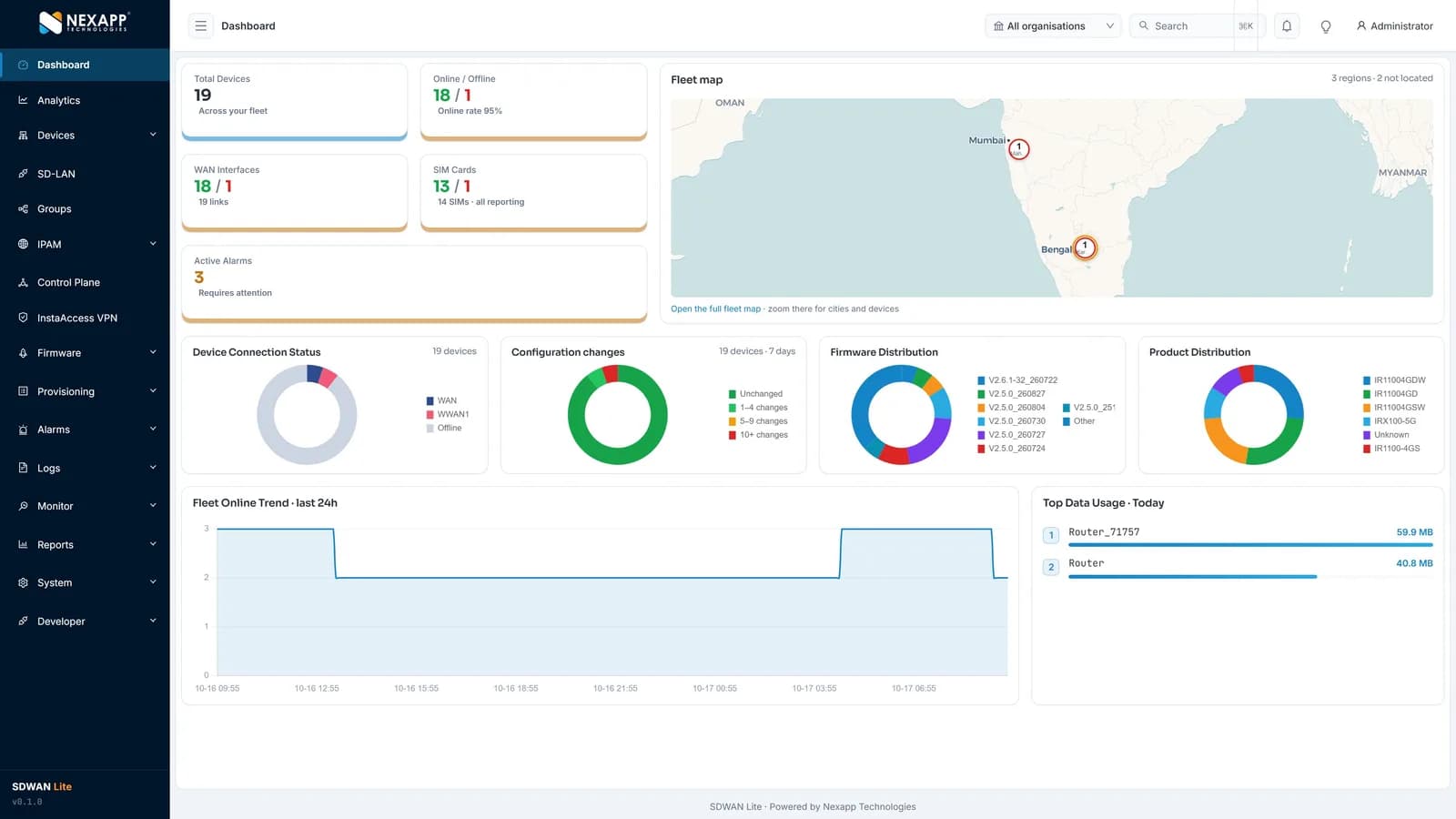
One screen shows the whole fleet: total devices and online rate, WAN links and SIM cards, active alarms, a fleet map, firmware versions, configuration changes, product mix and data usage. Instaroute SDWAN Lite 2.0 manages up to 100,000 routers per deployment, hosted by Nexapp in India or self-hosted.
How is it deployed?
A typical rollout takes 5 steps, and routers configure themselves when they are powered on at site.
Plan the rollout
Group DCUs by area and pick the router model per enclosure: single SIM, or dual SIM where coverage is weak.
Bulk pre-register
Upload serial numbers as a CSV and apply one template with per-site variables.
Install at the DCU
Connect the DCU over serial or Ethernet and power on; the router configures itself.
Send data to the HES
Meter data travels over MQTT or Modbus inside an encrypted tunnel to the head-end system.
Roll firmware in waves
Canary rollout updates a small group first, then the rest of the fleet.
What does the specification ask for, and how does Nexapp meet it?
These are the requirements buyers and tenders usually set for this application, and the Nexapp capability that meets each one today.
| Requirement | How Nexapp meets it |
|---|---|
| Low cost per site at scale | Flat per-device price, no per-GB or remote-access charges |
| Serial and Modbus interfaces | RS232/RS485 and a Modbus RTU/ASCII/TCP gateway; MQTT publisher |
| Rollout without engineers on site | Zero-touch provisioning from a CSV of serial numbers |
| Management platform under the utility's control | SDWAN Lite 2.0 hosted in India or self-hosted, up to 100,000 devices per deployment |
Which Instaroute router should you use?
For most sites, use the IR11004GS. Entry-level 4G with serial ports, sized for DCUs and meters.
IR11004GS
Entry-level 4G with serial ports, sized for DCUs and meters.
- Cellular
- 4G LTE Cat 4 or Cat 6
- SIM slots
- 1
- RS232 / RS485
- RS232 and RS485
- Mounting
- DIN-rail or wall
IR1180DM
DIN-rail, dual SIM and GPS for enclosures that need a second operator.
- Cellular
- 4G LTE Cat 4 or Cat 6
- SIM slots
- 2
- RS232 / RS485
- RS232 and RS485
- Mounting
- DIN-rail
Also used: Instaroute SDWAN Lite 2.0
What are the benefits?
- Predictable cost: one flat price per device, no per-GB or remote-access charges.
- Thousands of DCUs come online without an engineer configuring each router.
- Signal and data usage visible for every site from one console.
Why choose Nexapp?
- Indian OEM in Pune since 2014, with its own NexappOS and controller
- Class-I local supplier under the PPP-MII Order
- TEC MTCTE certificate 244903206 for nine Instaroute models
- Quantum-safe on every connection: hybrid ML-KEM and ML-DSA
- 24×7 NOC in Pune; hosted in India or self-hosted
- 75,000+ devices deployed for 400+ enterprise and banking customers
Frequently asked questions
Can one platform manage a large metering fleet?
Yes. Instaroute SDWAN Lite 2.0 manages up to 100,000 Lite Series routers per deployment, Nexapp-hosted in India or self-hosted.
Which protocols does the router support for meters?
Modbus RTU/ASCII/TCP, DNP3, IEC 60870-5-101/104 and MQTT publishing, plus RS232/RS485 serial over TCP or UDP.
How is the platform priced?
One flat price per device, quoted in INR, with no data metering and no remote-access data allowance.
Which router suits a data concentrator unit?
The IR11004GS for most DCUs: single SIM, one LAN and one WAN port, RS232 and RS485, and DIN-rail or wall mounting. Choose the IR1180DM where the enclosure needs a second operator's SIM.
How do we spot DCU sites with weak signal or an exhausted data plan?
SDWAN Lite 2.0 tracks signal and data usage for every SIM against its plan, ranks the worst-signal sites and raises alarms by email, webhook or in the console. The team can act before a DCU stops reporting.
What if the DCU sits in a basement meter room?
Mount the IP65 IR1105-ODU-4G outside or higher up where the signal is better and connect the DCU over Ethernet. The outdoor unit has no serial ports, so a DCU with only a serial output needs an indoor model such as the IR11004GS.
Read next
Planning a similar deployment?
Tell us your sites, devices and links, and a Nexapp engineer will recommend the routers and design.
Related use cases
Energy and utilities
4G router for substation SCADA and RTU/FRTU backhaulIndustrial 4G routers for substations, RTUs and FRTUs: IEC 60870-5-101/104, DNP3, Modbus, serial DTU and encrypted tunnels to the SCADA control centre.
Energy and utilities
Remote monitoring and connectivity for solar plantsOne managed network for inverters, meters, weather stations and cameras across solar farms and rooftop plants, with scoped vendor access and one console.
Energy and utilities
Secure remote access and monitoring for wind turbinesCellular connectivity and secure vendor access for wind turbine controllers and substations: dual-SIM 4G, IEC 104 and Modbus, logged ZTNA sessions.