

Energy and utilitiesSDWAN Lite
4G routers for RDSS smart metering and distribution automation
An RDSS project needs field communication for two systems at once: smart prepaid metering, where DCUs, gateways and DT, feeder and boundary meters report to the head-end system, and distribution automation, where FRTUs, RMUs and substation RTUs report to SCADA/DMS. Instaroute 4G routers are used in RDSS projects to carry both over dual-SIM cellular, in separate zones and quantum-safe tunnels with no public IP needed, and Instaroute SDWAN Lite 2.0 rolls out and manages thousands of field routers from one console.
By Pradeep Tomar, Founder and CEO. Published , last reviewed .At a glance
- Industry
- Discoms, AMISPs and system integrators
- Scope
- Consumer, DT, feeder and boundary metering; distribution automation
- Protocols
- IEC 60870-5-101/104, DNP3, Modbus, MQTT, serial
- Routers
- IR1180DM, IR11004GS, IR1105-ODU-4G
How does the network connect?
Site equipment connects to an Instaroute IR1180DM, which carries the traffic over SIM 1 · Operator A and SIM 2 · Operator B inside a quantum-safe tunnel to Head-end system (HES) and SCADA / DMS control centre. Nothing on site accepts inbound connections.
What problem does it solve?
The Revamped Distribution Sector Scheme (RDSS) is the Ministry of Power's scheme to improve the performance of power distribution companies. It funds smart prepaid metering for consumers, distribution transformers and feeders alongside distribution infrastructure and automation works, so one discom ends up with two field networks to build: metering to the head-end system, and automation to SCADA/DMS.
Both networks are spread across thousands of field points: DCUs on poles, DT meters in transformer enclosures, feeder and boundary meters at substations, FRTUs in RMUs and RTUs in control rooms. Many sit far from fibre or in weak-signal spots, prepaid billing depends on regular reads reaching the head end, and every site visit eats into the project budget.
Metering and SCADA are different systems, often run by different parties, and neither should share a flat network with the other. Field devices on mobile SIMs sit behind the operator's NAT, and exposing them on public IPs to reach them is not an option.
How does Nexapp solve it?
4G routers for RDSS projects: DCU, DT, feeder and boundary meter links to the HES, and FRTU, RMU and RTU links to SCADA over IEC 104, DNP3 and Modbus.
One router family for metering and automation
The same Instaroute 4G routers backhaul DCUs, gateways and DT, feeder and boundary meters to the head-end system and carry FRTU, RMU and RTU traffic to SCADA/DMS, so the discom and its integrators work with one platform and one set of templates.
Speaks metering and SCADA protocols
RS232/RS485 serial ports carry DCUs and meters over TCP or UDP, a Modbus RTU/ASCII/TCP gateway and MQTT publisher handle readings, and IEC 60870-5-101/104 and DNP3 connect FRTUs, RMUs and RTUs, so existing field devices connect without replacement.
Metering kept apart from SCADA
Zone firewall and VRF segmentation keep metering and automation traffic in separate zones, each in its own tunnel to its own head end, and APN settings per SIM let routers run on a private APN where the operator provides one.
Quantum-safe, with no public IP
Routers build outbound IPsec IKEv2 tunnels with hybrid post-quantum key exchange (ML-KEM, NIST FIPS 203), on by default, and keep an always-on management channel, so nothing in the field accepts inbound connections.
Rolled out zero-touch at discom scale
Import serial numbers as a CSV, apply templates per site type with per-site variables, and each router configures itself at first power-on. Instaroute SDWAN Lite 2.0 manages up to 100,000 devices per deployment, with canary firmware rollout and rollback, Nexapp-hosted in India or self-hosted.
How is the site secured in the AI era?
Security is a requirement, not an add-on. AI helps attackers find exposed devices and weak access faster than ever, so this design exposes nothing, encrypts every link and checks every person who connects.
Nothing exposed to the internet
The router opens only outbound, encrypted connections. Equipment on site has no public IP and accepts no inbound connections, so automated scanners have nothing to find. Zero trust access
Quantum-safe encryption on every link
Traffic travels in IPsec IKEv2 tunnels with hybrid ML-KEM key exchange, so data captured today cannot be decrypted later. Post-quantum cryptography
Zones, not one flat network
Each group of equipment on site gets its own zone behind the zone firewall, so one compromised device cannot reach the rest. IoT and OT security
Access for people, not networks
Engineers and vendors connect through InstaAccess to the named equipment they support, and every session is logged. SSE and ZTNA
Signed, staged firmware
Instaroute SDWAN Lite 2.0 rolls out post-quantum-signed firmware to a canary group first, with rollback, so a bad update never reaches every site at once. Instaroute SDWAN Lite 2.0
AI that waits for your approval
NexParth AI spots problems and proposes the fix, and nothing changes until a person approves it. NexParth AI
What does the SDWAN Lite dashboard show?
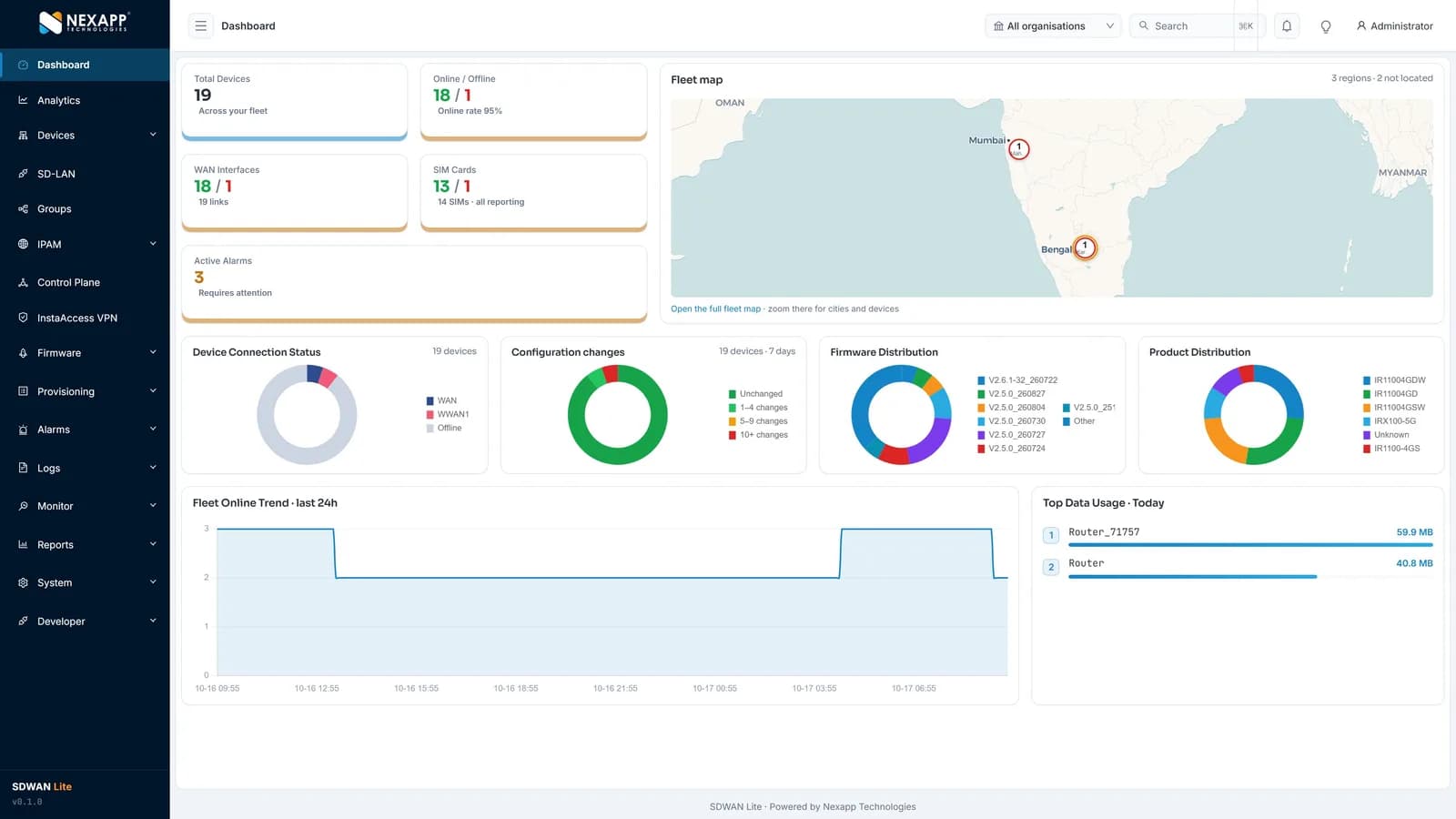
One screen shows the whole fleet: total devices and online rate, WAN links and SIM cards, active alarms, a fleet map, firmware versions, configuration changes, product mix and data usage. Instaroute SDWAN Lite 2.0 manages up to 100,000 routers per deployment, hosted by Nexapp in India or self-hosted.
How is it deployed?
A typical rollout takes 5 steps, and routers configure themselves when they are powered on at site.
Classify the field points
Group sites by type (DCU, DT meter, feeder or boundary meter, RMU/FRTU, substation RTU) and record each device's protocol and interface.
Template each site type
Set the head-end or SCADA master address, tunnel, serial and protocol settings and zone policy once per site type, with per-site variables.
Bulk pre-register
Import router serial numbers as a CSV and map each to its site and template before the field teams go out.
Install and power on
Mount the router in the DCU box, meter enclosure or panel, connect the device over serial or Ethernet, insert SIMs and power on; the router configures itself.
Operate the fleet
Watch signal, link health and data usage for every field point, give integrators scoped access, and roll firmware out in waves.
What does the specification ask for, and how does Nexapp meet it?
These are the requirements buyers and tenders usually set for this application, and the Nexapp capability that meets each one today.
| Requirement | How Nexapp meets it |
|---|---|
| Meter and DCU data to the head-end system | RS232/RS485 serial DTU over TCP or UDP; Modbus RTU/ASCII/TCP gateway; MQTT publisher |
| FRTU, RMU and RTU links to SCADA/DMS | IEC 60870-5-101/104 and DNP3; Modbus RTU/ASCII/TCP gateway |
| Metering separated from SCADA | Zone firewall and VRF segmentation; a separate tunnel per head end; private APN per SIM where the operator provides one |
| Encrypted links without a public IP | Outbound IPsec IKEv2 with hybrid ML-KEM key exchange and ML-DSA authentication; always-on management channel |
| Rollout and management at discom scale | Zero-touch provisioning from a CSV, templates, canary firmware rollout with rollback; up to 100,000 devices per deployment |
| Remote management, logging and time | SNMP v2c/v3, TR-069 and syslog; NTP set centrally; GPS on the IR1180DM |
| Indian telecom certification | TEC MTCTE certificate 244903206 covers the IR1180DM, IR11004GS and IR1105-ODU-4G |
Which Instaroute router should you use?
For most sites, use the IR1180DM. DIN-rail with dual SIM, RS232/RS485 and GPS for RMU, FRTU and substation RTU panels.
IR1180DM
DIN-rail with dual SIM, RS232/RS485 and GPS for RMU, FRTU and substation RTU panels.
- Cellular
- 4G LTE Cat 4 or Cat 6
- SIM slots
- 2
- RS232 / RS485
- RS232 and RS485
- Mounting
- DIN-rail
IR11004GS
Entry-level single-SIM 4G with serial ports for DCUs and DT meter boxes in large numbers.
- Cellular
- 4G LTE Cat 4 or Cat 6
- SIM slots
- 1
- RS232 / RS485
- RS232 and RS485
- Mounting
- DIN-rail or wall
IR1105-ODU-4G
IP65 dual-SIM unit on a pole or mast where a metal enclosure or control room weakens the signal.
- Cellular
- 4G LTE Cat 4 or Cat 6
- SIM slots
- 2
- RS232 / RS485
- No
- Mounting
- Outdoor, pole or mast
Also used: Instaroute SDWAN Lite 2.0 · InstaAccess client (ZTNA, SSL VPN, IPsec VPN)
What are the benefits?
- Metering and distribution automation run on one router family and one console.
- Existing DCUs, meters, FRTUs and RTUs connect without replacement.
- Metering and SCADA traffic stay in separate zones and tunnels.
- No field device is exposed to the internet, and no public IP is needed.
- Thousands of field routers come online without an engineer configuring each one.
- Signal, link health and data usage visible for every field point from one console.
Why choose Nexapp?
- Indian OEM in Pune since 2014, with its own NexappOS and controller
- Class-I local supplier under the PPP-MII Order
- TEC MTCTE certificate 244903206 for nine Instaroute models
- Quantum-safe on every connection: hybrid ML-KEM and ML-DSA
- 24×7 NOC in Pune; hosted in India or self-hosted
- 75,000+ devices deployed for 400+ enterprise and banking customers
Frequently asked questions
Which 4G router suits RDSS smart metering and SCADA links?
One that speaks both metering and SCADA protocols, runs on dual SIM where coverage is weak and can be managed in thousands. Instaroute uses the IR1180DM for RMU, FRTU and RTU panels, the IR11004GS for DCUs and DT meter boxes, and the IR1105-ODU-4G where the signal is weak.
Can a 4G router replace an old GPRS modem on a DT or feeder meter?
Yes, where the meter or DCU has an RS232/RS485 or Ethernet port. The router's serial DTU carries the data over TCP or UDP to the head-end system; confirm the HES connection settings with the AMISP.
Does the router support IEC 60870-5-104 for FRTU and RMU links to SCADA?
Yes. The router supports IEC 60870-5-101/104 and DNP3 and acts as a Modbus RTU/ASCII/TCP gateway, with traffic carried to SCADA/DMS in IPsec tunnels with hybrid post-quantum key exchange.
Can metering and SCADA traffic share one router?
Yes. Zone firewall and VRF segmentation put each system in its own zone, with its own tunnel to its own head end, so metering devices cannot reach SCADA equipment.
How do the HES and SCADA master reach devices behind mobile SIMs?
Through each system's own tunnel. Tunnels and the management channel are outbound, so field SIMs behind the operator's NAT work without public or static IPs, and metering and SCADA stay on separate paths.
How are thousands of field routers rolled out and managed?
Serial numbers are imported as a CSV, templates set per site type, and each router configures itself at first power-on. Instaroute SDWAN Lite 2.0 then handles alarms, data usage and firmware waves for up to 100,000 devices per deployment.
Read next
Planning a similar deployment?
Tell us your sites, devices and links, and a Nexapp engineer will recommend the routers and design.
Related use cases
Energy and utilities
4G router for substation SCADA and RTU/FRTU backhaulIndustrial 4G routers for substations, RTUs and FRTUs: IEC 60870-5-101/104, DNP3, Modbus, serial DTU and encrypted tunnels to the SCADA control centre.
Energy and utilities
Cellular backhaul for smart meters and data concentrator units4G routers for smart-meter data concentrator units (DCUs) and AMR: serial and Modbus interfaces, MQTT, encrypted tunnels and flat per-device management.
Energy and utilities
Remote monitoring and connectivity for solar plantsOne managed network for inverters, meters, weather stations and cameras across solar farms and rooftop plants, with scoped vendor access and one console.