

Energy and utilitiesSDWAN Lite
Remote monitoring and secure access for battery energy storage (BESS)
A battery energy storage system has to report its battery, inverter and climate data continuously and take commands, often at a site with no fibre yet. Instaroute routers read BMS, PCS, EMS and meter data over Modbus and serial, carry IEC 60870-5-104 or DNP3 to SCADA over encrypted 4G, keep each subsystem in its own zone and give integrators scoped, logged access.
By Pradeep Tomar, Founder and CEO. Published , last reviewed .At a glance
- Industry
- Energy storage, renewables, commercial and industrial (C&I) sites
- Sites
- BESS containers at plants, substations and premises
- Devices
- BMS, PCS, EMS, HVAC, meters, CCTV
- Routers
- IR1190DMG, IR1180DM, IR1105-ODU-4G
How does the network connect?
Site equipment connects to an Instaroute IR1190DMG, which carries the traffic over SIM 1 · Operator A and SIM 2 · Operator B inside a quantum-safe tunnel to SCADA / monitoring platform and Integrators via InstaAccess. Nothing on site accepts inbound connections.
What problem does it solve?
A BESS site brings together systems from several suppliers: battery racks and their BMS, the power conversion system, the energy management system, HVAC and meters. Each speaks its own protocol, and all of it has to reach the owner's SCADA or monitoring platform.
Battery, inverter and EMS suppliers need remote access for diagnostics and warranty work. A shared VPN account or an open port gives them the whole site, and nobody knows who connected.
For energy storage of 50 MW or more, the CEA (Cyber Security in Power Sector) Regulations, 2026 come into force on 1 April 2027. They ask for segmented OT, approved and logged remote access, and sensitive data kept in India.
How does Nexapp solve it?
Connect BESS containers to SCADA: BMS, PCS and EMS data over Modbus, IEC 104 or DNP3, segmented zones, logged integrator access and encrypted 4G links.
Speaks the site's protocols
RS232/RS485 serial ports, a Modbus RTU/ASCII/TCP gateway, DNP3, IEC 60870-5-101/104 and an MQTT publisher, so existing controllers, RTUs and meters connect without replacement.
Each system in its own zone
Zone firewall and VRF segmentation put the BMS, PCS, HVAC and CCTV in separate zones, with only the traffic your policy allows crossing between them and logs exported to your SIEM.
Vendor access without open ports
Engineers and equipment vendors connect through the InstaAccess client (ZTNA, SSL VPN or IPsec VPN) to only the equipment they support, and every session is logged.
Encrypted end to end
IPsec IKEv2 tunnels on NexappOS with hybrid post-quantum key exchange (ML-KEM, NIST FIPS 203), on by default, back to the control centre.
One console for every site
Instaroute SDWAN Lite 2.0 shows the health, signal and data usage of every router, with zero-touch set-up and canary firmware rollout, for up to 100,000 devices per deployment. Run it Nexapp-hosted in India or self-hosted.
How is the site secured in the AI era?
Security is a requirement, not an add-on. AI helps attackers find exposed devices and weak access faster than ever, so this design exposes nothing, encrypts every link and checks every person who connects.
Nothing exposed to the internet
The router opens only outbound, encrypted connections. Equipment on site has no public IP and accepts no inbound connections, so automated scanners have nothing to find. Zero trust access
Quantum-safe encryption on every link
Traffic travels in IPsec IKEv2 tunnels with hybrid ML-KEM key exchange, so data captured today cannot be decrypted later. Post-quantum cryptography
Zones, not one flat network
Each group of equipment on site gets its own zone behind the zone firewall, so one compromised device cannot reach the rest. IoT and OT security
Access for people, not networks
Engineers and vendors connect through InstaAccess to the named equipment they support, and every session is logged. SSE and ZTNA
Signed, staged firmware
Instaroute SDWAN Lite 2.0 rolls out post-quantum-signed firmware to a canary group first, with rollback, so a bad update never reaches every site at once. Instaroute SDWAN Lite 2.0
AI that waits for your approval
NexParth AI spots problems and proposes the fix, and nothing changes until a person approves it. NexParth AI
What does the SDWAN Lite dashboard show?
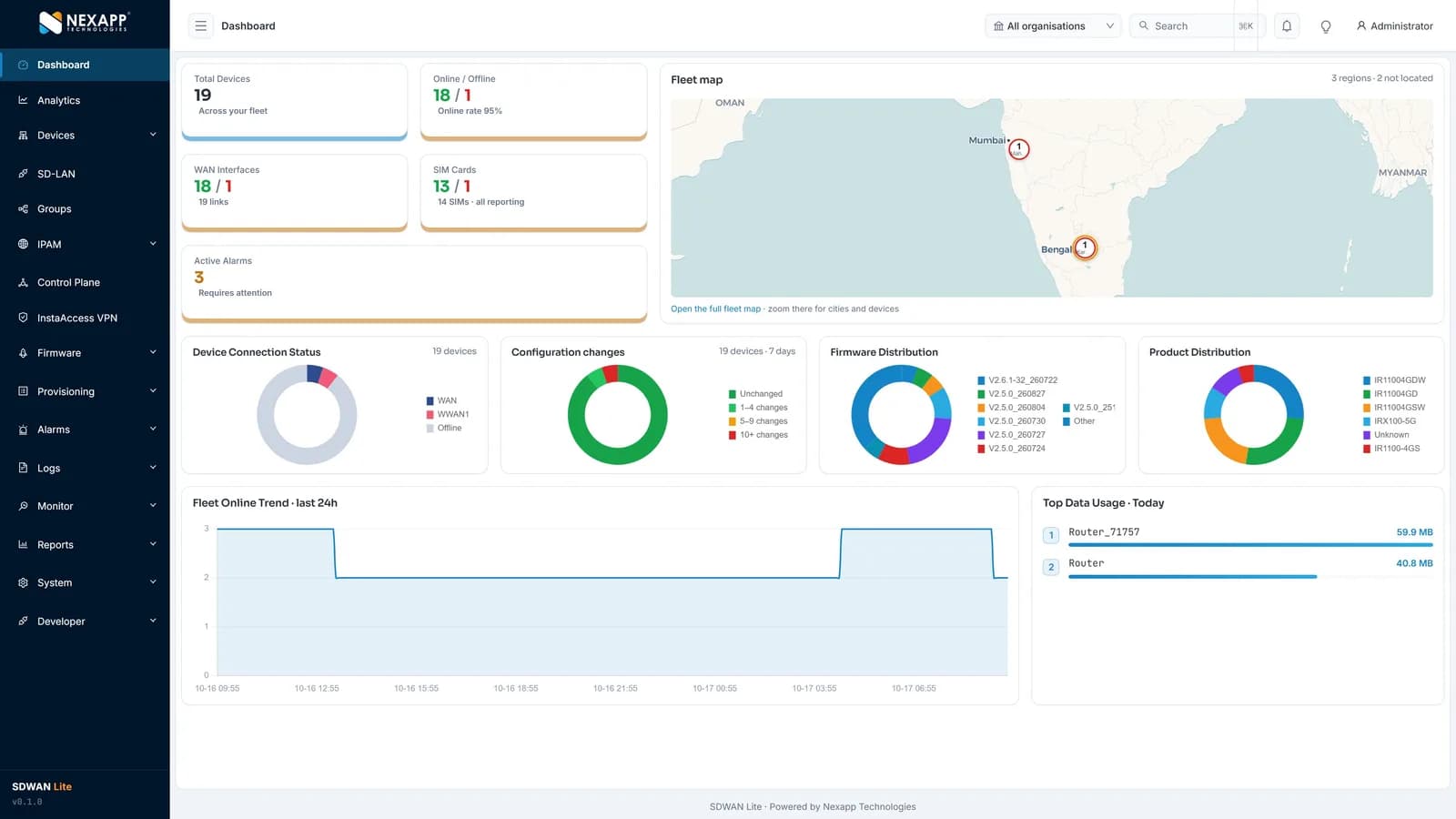
One screen shows the whole fleet: total devices and online rate, WAN links and SIM cards, active alarms, a fleet map, firmware versions, configuration changes, product mix and data usage. Instaroute SDWAN Lite 2.0 manages up to 100,000 routers per deployment, hosted by Nexapp in India or self-hosted.
How is it deployed?
A typical rollout takes 5 steps, and routers configure themselves when they are powered on at site.
Map the subsystems
List the BMS, PCS, EMS, HVAC and meters with their protocol and interface, and decide which zone each belongs in.
Template the router
Set the SCADA master address, tunnel, serial and Modbus settings and zone policy once, as a template.
Install in the control cabinet
Mount the DIN-rail router, connect the subsystems, and add an outdoor unit on a mast if the container weakens the signal.
Connect SCADA and vendors
Data travels to SCADA in an outbound encrypted tunnel; integrators get InstaAccess rights to their own equipment only.
Monitor and audit
Alarms, firmware and session logs for every storage site sit in one console, with syslog export to your SIEM.
What does the specification ask for, and how does Nexapp meet it?
These are the requirements buyers and tenders usually set for this application, and the Nexapp capability that meets each one today.
| Requirement | How Nexapp meets it |
|---|---|
| BMS, PCS and meter data on Modbus or serial | Modbus RTU/ASCII/TCP gateway; RS232/RS485 serial DTU over TCP or UDP; MQTT publisher |
| SCADA protocols | IEC 60870-5-101/104 and DNP3 |
| OT segmented into zones | Zone firewall and VRF segmentation on the router |
| Approved, monitored and logged remote access | InstaAccess (ZTNA, SSL VPN or IPsec VPN) to named devices, every session logged |
| Encrypted link to the control centre | IPsec IKEv2 with hybrid ML-KEM key exchange and ML-DSA authentication |
| Data and logs kept in India | SDWAN Lite 2.0 hosted by Nexapp in India or self-hosted; syslog export to your SIEM |
| Clock synchronisation | NTP servers set centrally; GPS on the IR1180DM |
Which Instaroute router should you use?
For most sites, use the IR1190DMG. Gigabit DIN-rail router with dual SIM and serial ports for the BESS control cabinet; no Wi-Fi.
IR1190DMG
Gigabit DIN-rail router with dual SIM and serial ports for the BESS control cabinet; no Wi-Fi.
- Cellular
- 4G LTE Cat 4 or Cat 6
- SIM slots
- 2
- RS232 / RS485
- RS232 and RS485
- Mounting
- DIN-rail or wall
IR1180DM
DIN-rail with dual SIM, RS232/RS485 and GPS for location and time data.
- Cellular
- 4G LTE Cat 4 or Cat 6
- SIM slots
- 2
- RS232 / RS485
- RS232 and RS485
- Mounting
- DIN-rail
IR1105-ODU-4G
IP65 outdoor unit on a pole or mast where the steel containers weaken the signal inside.
- Cellular
- 4G LTE Cat 4 or Cat 6
- SIM slots
- 2
- RS232 / RS485
- No
- Mounting
- Outdoor, pole or mast
Also used: Instaroute SDWAN Lite 2.0 · InstaAccess client (ZTNA, SSL VPN, IPsec VPN)
What are the benefits?
- BMS, PCS and EMS data reach SCADA without replacing any controller.
- Each subsystem sits in its own zone, so one compromised device cannot reach the rest.
- Integrators reach only the equipment they support, and every session is logged.
- Management and logs hosted in India or self-hosted, under the owner's control.
- A second operator ready on dual-SIM models for continuous reporting.
- Every storage site visible and updatable from one console.
Why choose Nexapp?
- Indian OEM in Pune since 2014, with its own NexappOS and controller
- Class-I local supplier under the PPP-MII Order
- TEC MTCTE certificate 244903206 for nine Instaroute models
- Quantum-safe on every connection: hybrid ML-KEM and ML-DSA
- 24×7 NOC in Pune; hosted in India or self-hosted
- 75,000+ devices deployed for 400+ enterprise and banking customers
Frequently asked questions
Can the router read BMS and PCS data over Modbus?
Yes. The router acts as a Modbus RTU/ASCII/TCP gateway, so BMS, PCS and EMS data from different suppliers in one container reaches SCADA without a separate protocol converter. It can also publish readings over MQTT.
Does it support IEC 60870-5-104 and DNP3 for SCADA?
Yes. The router supports IEC 60870-5-101/104 and DNP3, carried to the control centre in IPsec tunnels with hybrid post-quantum key exchange.
Can the battery supplier run diagnostics without reaching the PCS?
Yes. Each supplier's InstaAccess policy names only its own devices, so the battery maker reaches the BMS and the inverter maker the PCS. Nothing on site accepts inbound connections, and every session is logged for the owner's records.
Do the CEA Cyber Security Regulations 2026 apply to BESS?
They apply to energy storage of 50 MW or more from 1 April 2027. The obligations sit with the owner; Nexapp supports the network clauses such as segmentation, logged remote access and data kept in India.
Will the router work inside a steel BESS container?
Steel enclosures weaken cellular signal. Mount the IP65 IR1105-ODU-4G on a pole or mast where the signal is best and run a cable to the cabinet.
Read next
Planning a similar deployment?
Tell us your sites, devices and links, and a Nexapp engineer will recommend the routers and design.
Related use cases
Energy and utilities
4G router for substation SCADA and RTU/FRTU backhaulIndustrial 4G routers for substations, RTUs and FRTUs: IEC 60870-5-101/104, DNP3, Modbus, serial DTU and encrypted tunnels to the SCADA control centre.
Energy and utilities
Cellular backhaul for smart meters and data concentrator units4G routers for smart-meter data concentrator units (DCUs) and AMR: serial and Modbus interfaces, MQTT, encrypted tunnels and flat per-device management.
Energy and utilities
Remote monitoring and connectivity for solar plantsOne managed network for inverters, meters, weather stations and cameras across solar farms and rooftop plants, with scoped vendor access and one console.