

Industrial and manufacturingSDWAN Lite
Wireless connectivity for machines across the factory floor
Connecting machines and sensors on a busy shop floor usually means trenching and cabling, which is slow, costly and disrupts production. Nexapp connects them over Wi-Fi instead: IRX100 5G routers have dual-band Wi-Fi 6, dedicated access points are available on request for larger floors, and machines, staff and guests sit on separate networks kept apart by the firewall.
By Pradeep Tomar, Founder and CEO. Published , last reviewed .At a glance
- Industry
- Manufacturing
- Sites
- Factory floors and warehouses
- Products
- Enterprise Wi-Fi, Instaroute IRX100
- Focus
- Machine connectivity over Wi-Fi
How does the network connect?
Site equipment connects to an Instaroute IRX100-5G, which carries the traffic over Wi-Fi 6 on IRX100 · access points on request and Plant LAN inside a quantum-safe tunnel to Plant systems and MES. Nothing on site accepts inbound connections.
What problem does it solve?
Production lines are rearranged, so fixed cabling quickly goes out of date.
Machines, staff devices and guests end up on one network unless it is designed otherwise.
Many Indian shop floors run three shifts, so trenching or running cable trays means stopping a line or working around one. Older machines on the floor often have only a serial port, contract staff and visitors bring their own phones, and the plant's IT team is small. The wireless network has to connect old and new machines, keep people's devices off the production network and be managed without a specialist on every shift.
How does Nexapp solve it?
Connect shop-floor machines and sensors over Wi-Fi: Wi-Fi 6 on IRX100 routers, dedicated access points on request, machine and staff networks kept apart.
Wi-Fi on the floor
IRX100 5G routers have dual-band Wi-Fi 6 for machines and sensors near the router. Where the floor needs more coverage, dedicated access points are available on request, sized by a site survey.
Separate networks for machines and people
Machines, staff and guests get their own SSIDs and VLANs, kept apart by the firewall.
Speaks the site's protocols
RS232/RS485 serial ports, a Modbus RTU/ASCII/TCP gateway, DNP3, IEC 60870-5-101/104 and an MQTT publisher, so existing controllers, RTUs and meters connect without replacement.
One console for every site
Instaroute SDWAN Lite 2.0 shows the health, signal and data usage of every router, with zero-touch set-up and canary firmware rollout, for up to 100,000 devices per deployment. Run it Nexapp-hosted in India or self-hosted.
How is the site secured in the AI era?
Security is a requirement, not an add-on. AI helps attackers find exposed devices and weak access faster than ever, so this design exposes nothing, encrypts every link and checks every person who connects.
Nothing exposed to the internet
The router opens only outbound, encrypted connections. Equipment on site has no public IP and accepts no inbound connections, so automated scanners have nothing to find. Zero trust access
Quantum-safe encryption on every link
Traffic travels in IPsec IKEv2 tunnels with hybrid ML-KEM key exchange, so data captured today cannot be decrypted later. Post-quantum cryptography
Zones, not one flat network
Each group of equipment on site gets its own zone behind the zone firewall, so one compromised device cannot reach the rest. IoT and OT security
Access for people, not networks
Engineers and vendors connect through InstaAccess to the named equipment they support, and every session is logged. SSE and ZTNA
Signed, staged firmware
Instaroute SDWAN Lite 2.0 rolls out post-quantum-signed firmware to a canary group first, with rollback, so a bad update never reaches every site at once. Instaroute SDWAN Lite 2.0
AI that waits for your approval
NexParth AI spots problems and proposes the fix, and nothing changes until a person approves it. NexParth AI
What does the SDWAN Lite dashboard show?
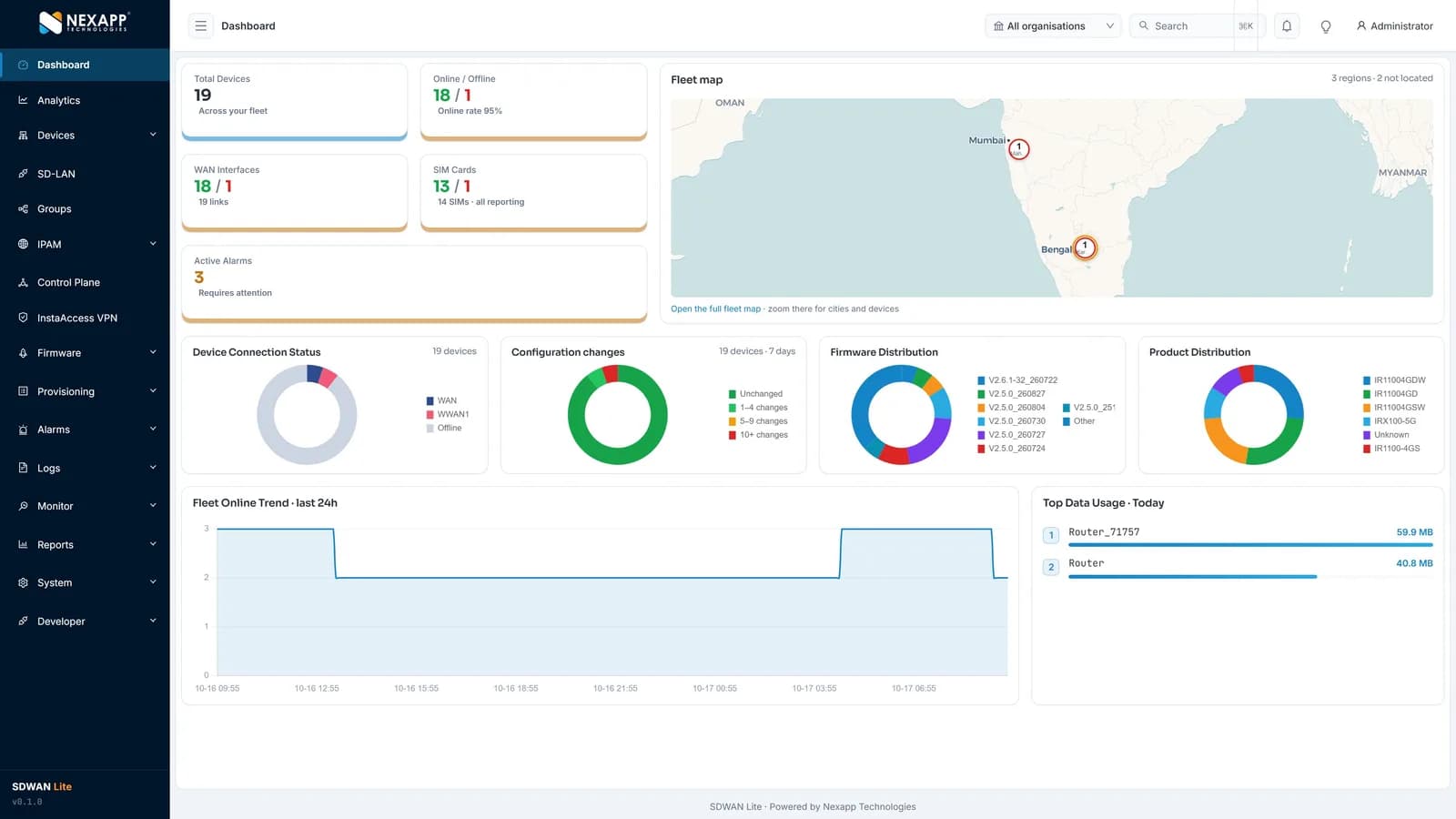
One screen shows the whole fleet: total devices and online rate, WAN links and SIM cards, active alarms, a fleet map, firmware versions, configuration changes, product mix and data usage. Instaroute SDWAN Lite 2.0 manages up to 100,000 routers per deployment, hosted by Nexapp in India or self-hosted.
How is it deployed?
A typical rollout takes 4 steps, and routers configure themselves when they are powered on at site.
Survey the floor
List the machines and sensors that need a connection and check Wi-Fi coverage where they stand.
Place the router and access points
Place the IRX100 router so its Wi-Fi 6 reaches the nearest machines, and add dedicated access points, available on request, where the survey shows gaps.
Separate the networks
Machines, staff and guests get their own SSIDs and VLANs, kept apart by the firewall.
Move with the line
When a line is rearranged, machines on Wi-Fi move with it without a new cable run to each one; recheck coverage at the new positions.
What does the specification ask for, and how does Nexapp meet it?
These are the requirements buyers and tenders usually set for this application, and the Nexapp capability that meets each one today.
| Requirement | How Nexapp meets it |
|---|---|
| Connect machines without trenching | Dual-band Wi-Fi 6 on IRX100 routers; dedicated access points on request |
| Keep production traffic separate | Separate SSIDs and VLANs per group, enforced by the firewall |
| Industrial protocols on the wired side | Modbus gateway and serial ports on Instaroute routers |
| Manage from one place | Instaroute SDWAN Lite 2.0 for every router on the floor |
Which Instaroute router should you use?
For most sites, use the IRX100-5G. 5G edge with dual-band Wi-Fi 6 and Gigabit ports for machines and sensors on the floor.
IRX100-5G
5G edge with dual-band Wi-Fi 6 and Gigabit ports for machines and sensors on the floor.
- Cellular
- 5G SA/NSA, sub-6 GHz
- SIM slots
- 2
- RS232 / RS485
- RS232 and RS485 (up to 3 ports)
- Mounting
- Desktop or wall
IR1190DMG
Wired-only Gigabit DIN-rail model for machine cabinets on the wired side.
- Cellular
- 4G LTE Cat 4 or Cat 6
- SIM slots
- 2
- RS232 / RS485
- RS232 and RS485
- Mounting
- DIN-rail or wall
Also used: Enterprise Wi-Fi · Instaroute SDWAN Lite 2.0
What are the benefits?
- Machines join over Wi-Fi instead of a new cable run to each one.
- Machines on Wi-Fi move with the line when the layout changes.
- Production traffic stays separate from staff and guest Wi-Fi.
Why choose Nexapp?
- Indian OEM in Pune since 2014, with its own NexappOS and controller
- Class-I local supplier under the PPP-MII Order
- TEC MTCTE certificate 244903206 for nine Instaroute models
- Quantum-safe on every connection: hybrid ML-KEM and ML-DSA
- 24×7 NOC in Pune; hosted in India or self-hosted
- 75,000+ devices deployed for 400+ enterprise and banking customers
Frequently asked questions
Are dedicated access points available?
Yes, dedicated access points are available on request for floors that need more coverage than the router's own Wi-Fi gives. On a small floor or cell, the dual-band Wi-Fi 6 on IRX100 5G routers may be enough; a site survey decides.
Are machines separated from staff and guest devices?
Yes. Each group gets its own SSID and VLAN, kept apart by the firewall.
Can the plant edge router provide Wi-Fi itself?
Depending on the model. IRX100 5G routers have dual-band Wi-Fi 6 for a small floor or office, IR1100 4G models have 2.4 GHz Wi-Fi, and the IR1190DMG is wired-only for cabinets where Wi-Fi is not wanted.
How can a machine with only a serial port join the network?
Connect it to an Instaroute router with RS232/RS485; the serial DTU carries its data over TCP or UDP. Wi-Fi-capable models also support station mode, so a router at the machine can join the floor Wi-Fi as a client instead of needing a cable.
How is the machine Wi-Fi secured?
With WPA2 encryption (CCMP), SSID access control and per-SSID isolation, plus the zone firewall between the machine VLAN and everything else.
Can machine data reach our MES or a cloud platform?
Yes. The Modbus gateway reads machine controllers, and the MQTT publisher sends the data to the MES or a cloud platform over the plant's link.
Read next
Planning a similar deployment?
Tell us your sites, devices and links, and a Nexapp engineer will recommend the routers and design.
Related use cases
Industrial and manufacturing
Secure remote access to PLCs, HMIs and machinesLet machine builders and engineers reach PLCs and HMIs without opening the plant network: InstaAccess ZTNA, SD-LAN behind the router, logged sessions.
Industrial and manufacturing
Central management and IT/OT segmentation for plant networksSeparate plant OT from office IT with zone firewalls and VRFs on Instaroute routers, link every plant to head office and manage plant networks from one console.
Industrial and manufacturing
Machine monitoring and predictive maintenance connectivityRead Modbus and serial data from motors, compressors, DG sets and CNC machines and publish it over MQTT to your platform, over plant LAN or 4G, apart from IT.