

Industrial and manufacturingSDWAN Lite
Internet and CCTV for construction sites over 4G/5G
A construction site needs internet from day one and only for as long as the project runs, usually long before a fixed line could arrive. Instaroute 4G/5G routers connect the site office, CCTV and time-lapse cameras and attendance devices over cellular, with an IP65 outdoor unit on a mast where the signal is weak, and move to the next site when the project ends.
By Pradeep Tomar, Founder and CEO. Published , last reviewed .At a glance
- Industry
- Construction, infrastructure, real estate
- Sites
- Building, road and infrastructure projects
- Devices
- Site office, CCTV, time-lapse cameras, attendance
- Routers
- IRX100-5G, IR1105-ODU-4G, IRX1160-ODU-5G
How does the network connect?
Site equipment connects to an Instaroute IRX100-5G, which carries the traffic over SIM 1 · Operator A and SIM 2 · Operator B inside a quantum-safe tunnel to Head office and project team and Video management system. Nothing on site accepts inbound connections.
What problem does it solve?
A fixed line can take weeks to arrive, and a project may run for only months. The site office, cameras and attendance devices need a link on the day the gate opens.
Signal changes as the structure rises and steel and concrete go up, and the site office often sits in a container at the edge of the plot.
Project teams and owners want to see the cameras from head office, but mobile SIMs in India usually sit behind carrier-grade NAT, so port forwarding to the recorder does not work.
How does Nexapp solve it?
4G/5G internet for construction sites: site office, CCTV, time-lapse cameras and attendance devices online from day one, with a mast unit for weak signal.
Online on day one
Routers are pre-registered by serial number and pull their full configuration when they are powered on at site, so a new site needs no network engineer on the day.
On the mast, where the signal is
The IP65 IR1105-ODU-4G or IRX1160-ODU-5G mounts on a pole or mast above the site office and connects to it over its LAN port. Move it as the site changes.
Cameras viewable without a public IP
The router builds outbound encrypted tunnels to the head office or video management system, so cameras and recorders are viewed remotely without port forwarding.
Each system in its own zone
Zone firewall separates cameras, attendance devices and office users, so a visitor's laptop cannot reach the recorder.
One console for every site
Instaroute SDWAN Lite 2.0 shows the health, signal and data usage of every router, with zero-touch set-up and canary firmware rollout, for up to 100,000 devices per deployment. Run it Nexapp-hosted in India or self-hosted.
How is the site secured in the AI era?
Security is a requirement, not an add-on. AI helps attackers find exposed devices and weak access faster than ever, so this design exposes nothing, encrypts every link and checks every person who connects.
Nothing exposed to the internet
The router opens only outbound, encrypted connections. Equipment on site has no public IP and accepts no inbound connections, so automated scanners have nothing to find. Zero trust access
Quantum-safe encryption on every link
Traffic travels in IPsec IKEv2 tunnels with hybrid ML-KEM key exchange, so data captured today cannot be decrypted later. Post-quantum cryptography
Zones, not one flat network
Each group of equipment on site gets its own zone behind the zone firewall, so one compromised device cannot reach the rest. IoT and OT security
Access for people, not networks
Engineers and vendors connect through InstaAccess to the named equipment they support, and every session is logged. SSE and ZTNA
Signed, staged firmware
Instaroute SDWAN Lite 2.0 rolls out post-quantum-signed firmware to a canary group first, with rollback, so a bad update never reaches every site at once. Instaroute SDWAN Lite 2.0
AI that waits for your approval
NexParth AI spots problems and proposes the fix, and nothing changes until a person approves it. NexParth AI
What does the SDWAN Lite dashboard show?
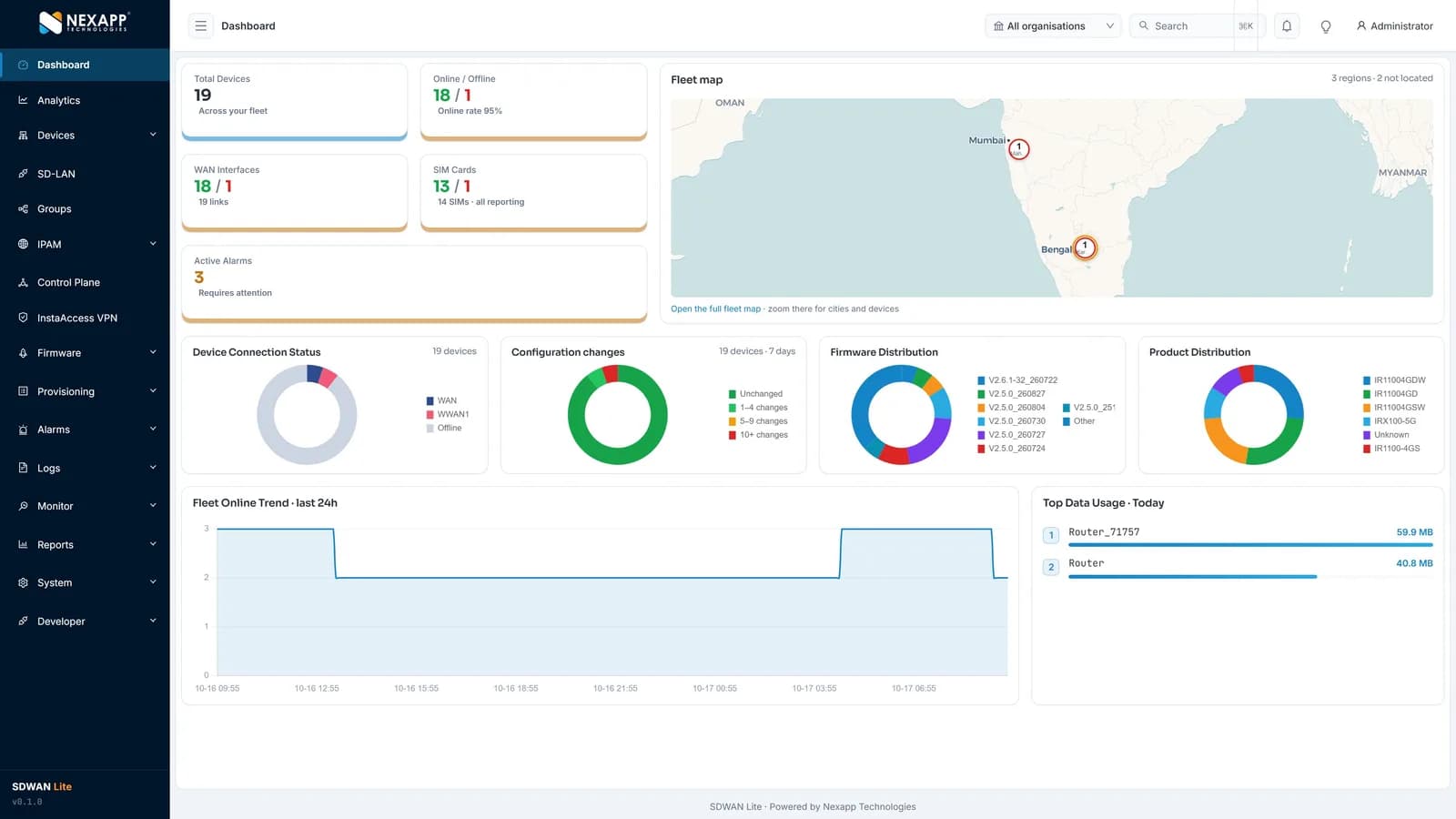
One screen shows the whole fleet: total devices and online rate, WAN links and SIM cards, active alarms, a fleet map, firmware versions, configuration changes, product mix and data usage. Instaroute SDWAN Lite 2.0 manages up to 100,000 routers per deployment, hosted by Nexapp in India or self-hosted.
How is it deployed?
A typical rollout takes 5 steps, and routers configure themselves when they are powered on at site.
Survey
Check 4G and 5G signal at the site office and at the best mast position, for at least two operators.
Pre-register
Register the router serial numbers and apply the project template with the tunnel to head office or the video system.
Install
Mount the outdoor unit on the mast if needed, connect the site office switch, cameras and attendance devices, and power on.
View and operate
Head office views the cameras through the tunnel and watches signal and data usage for every site.
Move on
When the project ends, take the router to the next site and apply that site's template.
What does the specification ask for, and how does Nexapp meet it?
These are the requirements buyers and tenders usually set for this application, and the Nexapp capability that meets each one today.
| Requirement | How Nexapp meets it |
|---|---|
| Internet before a fixed line arrives | 4G LTE and 5G SA/NSA routers, live on power-on |
| Signal at a site office in a container | IP65 IR1105-ODU-4G or IRX1160-ODU-5G on a pole or mast |
| Remote camera viewing on SIMs without a public IP | Outbound IPsec, OpenVPN, GRE or DMVPN tunnels to the head office or video system |
| Upload for several cameras | 5G with Gigabit ports on the IRX100-5G; local recording with sub-streams sent upstream |
| Cameras separate from office and visitor devices | Zone firewall on the router |
| Many short-lived sites managed centrally | Zero-touch provisioning and templates in SDWAN Lite 2.0, hosted in India or self-hosted |
Which Instaroute router should you use?
For most sites, use the IRX100-5G. 5G with Gigabit ports and Wi-Fi 6 for the site office, cameras and attendance devices.
IRX100-5G
5G with Gigabit ports and Wi-Fi 6 for the site office, cameras and attendance devices.
- Cellular
- 5G SA/NSA, sub-6 GHz
- SIM slots
- 2
- RS232 / RS485
- RS232 and RS485 (up to 3 ports)
- Mounting
- Desktop or wall
IR1105-ODU-4G
IP65 dual-SIM 4G unit for the mast where indoor signal is weak.
- Cellular
- 4G LTE Cat 4 or Cat 6
- SIM slots
- 2
- RS232 / RS485
- No
- Mounting
- Outdoor, pole or mast
IRX1160-ODU-5G
IP65 5G unit for the mast where 5G is available and more upload is needed.
- Cellular
- 5G SA/NSA, sub-6 GHz
- SIM slots
- 1
- RS232 / RS485
- No
- Mounting
- Outdoor, pole or mast
Also used: Instaroute SDWAN Lite 2.0
What are the benefits?
- Sites go live on day one, without waiting for a fixed line.
- Routers move to the next project when the site closes.
- Cameras are viewed from head office without a public IP.
- Cameras, attendance devices and office users are kept apart.
- A mast-mounted unit keeps the link up as the structure rises.
- Every project site is visible from one console.
Why choose Nexapp?
- Indian OEM in Pune since 2014, with its own NexappOS and controller
- Class-I local supplier under the PPP-MII Order
- TEC MTCTE certificate 244903206 for nine Instaroute models
- Quantum-safe on every connection: hybrid ML-KEM and ML-DSA
- 24×7 NOC in Pune; hosted in India or self-hosted
- 75,000+ devices deployed for 400+ enterprise and banking customers
Frequently asked questions
Which router is best for a construction site?
A 4G or 5G router with Ethernet for cameras and the site office, Wi-Fi for staff and central management. The IRX100-5G fits most site offices; add an IP65 IR1105-ODU-4G or IRX1160-ODU-5G on a mast where indoor signal is weak.
How much upload do construction site cameras need?
Add up the bitrates of the streams that leave the site at the same time and keep at least 30% headroom. Cameras that record locally and send only sub-streams or clips need far less upload.
Can we view site cameras without a static IP?
Yes. The router builds an outbound encrypted tunnel to your head office or video management system, so the SIM can stay behind the operator's NAT.
Does the router power the cameras?
Power the cameras from a PoE switch or injector; the router's Ethernet ports carry their data.
Can the routers be reused on the next project?
Yes. Move the router to the new site, apply that site's template from the console and power it on.
Read next
Planning a similar deployment?
Tell us your sites, devices and links, and a Nexapp engineer will recommend the routers and design.
Related use cases
Industrial and manufacturing
Secure remote access to PLCs, HMIs and machinesLet machine builders and engineers reach PLCs and HMIs without opening the plant network: InstaAccess ZTNA, SD-LAN behind the router, logged sessions.
Industrial and manufacturing
Central management and IT/OT segmentation for plant networksSeparate plant OT from office IT with zone firewalls and VRFs on Instaroute routers, link every plant to head office and manage plant networks from one console.
Industrial and manufacturing
Wireless connectivity for machines across the factory floorConnect shop-floor machines and sensors over Wi-Fi: Wi-Fi 6 on IRX100 routers, dedicated access points on request, machine and staff networks kept apart.