

Securing IoT Devices and Data Protection
We are living in an age of connectivity, where data is deemed to be the new currency. Internet of Things (IoT) has become the crux of the majority of the connections. Devices are connected across the globe and industries to enhance productivity, create new business opportunities and solve probl
Short answer: IoT and IIoT devices face device hijacking, exploitable firmware and interfaces, unvalidated communication channels and man-in-the-middle attacks. Securing them needs end-to-end encrypted communication, continuous monitoring of devices and traffic, and lifecycle management that covers key replacement and safe decommissioning.
We are living in an age of connectivity, where data is deemed to be the new currency. Internet of Things (IoT) has become the crux of the majority of the connections. Devices are connected across the globe and industries to enhance productivity, create new business opportunities and solve problems. But this connectivity comes with its set of risks and threats that can impact the entire working of any organization.
With the growing need for the use of applications dependent on the cloud today, industries are focused on safeguarding their data from these threats by adopting new strategies to manage and mitigate cyber threats.
What are the main IoT security challenges?
- Device hijacking – The attacker hijacks and controls the device. These attacks can be difficult to detect, as attackers do not modify the basic functionality of the device. In an IIoT scenario, the hijacker could take control of a smart meter and use the compromised device to launch ransomware attacks against an energy management system (EMS).
- Devices/ Hardware interface – Susceptibility in memory, firmware, web interface and network services are easily exploited by hackers.
- Communication channels – Various protocols used for communication of IoT devices do not check the data that is being transported which means that the information can be really anything, posing data validation issues on the connected systems.
- Man in the middle – An attacker breaches, disrupts, or tampers with communications between two systems. In an IIoT situation, the attacker can take control of an intelligent actuator and can manipulate speed limit, which can damage an assembly line or cause damage.
How do you secure IoT devices and data?
- Secure communication (end-to-end communication) – The secure communication function protects the data transmitted between the device and its service infrastructure (cloud). Encryption ensures that only those with access to the secret decryption key can read the data.
- Security monitoring and analysis – Security monitoring captures data on the general state of industrial systems, including endpoint devices and connection traffic. Then the data is analyzed to detect possible security violations or potential system threats. When discovered, a wide range of actions formulated in the context of the entire system security policy should be performed. This can be executed in real time or at a later date to identify the use pattern and detect a potential attack scenario. It is crucial to ensure that endpoint devices are protected from possible manipulations and data operations.
- Security lifecycle management – Lifecycle management capabilities enable service providers and OEMs to control the security aspects of IoT devices at runtime. Rapid replacement of wireless device keys (OTA) during network disaster recovery makes sure that service interruptions are minimized. Additionally, the secure decommissioning of equipment ensures that end-of-life equipment is not reused or used to connect to service without authorization.
Security challenges for IoT service providers and their client companies are on the rise. Emphasis on the security side is crucial before it is too late. SD-WAN is evolving to become a preferred platform to manage these functions and capabilities in various upcoming technologies, especially IoT. As the IoT industry continues to grow at a fast pace, new services, security becomes an area that cannot be ignored anymore. Nexapp’s Instaroute routers carry IEC 62443 certification and protect connections with post-quantum cryptography, including post-quantum-signed firmware.
Related: secure IoT and M2M connectivity, post-quantum cryptography on Nexapp devices and IoT/OT security and other SASE capabilities.
Frequently asked questions
What are the biggest IoT security threats?
The main threats are device hijacking, weaknesses in firmware, memory and web interfaces, communication channels that do not validate data, and man-in-the-middle attacks on traffic between systems.
How does encryption protect IoT data?
End-to-end encryption protects data between the device and its cloud service, so only a party holding the right key can read it, even if the traffic is intercepted.
Can SD-WAN help secure IoT devices?
Yes. SD-WAN can segment IoT traffic and inspect it at the edge. Nexapp's platform includes IoT/OT security, and its SD-WAN edges add IPS, gateway antivirus and web filtering.
Is post-quantum encryption available for IoT routers?
Yes. Nexapp's post-quantum cryptography is generally available on its routers and SD-WAN, with hybrid ML-KEM key exchange and post-quantum-signed firmware and configuration.
To learn more about IoT security, see Nexapp’s IoT and M2M solutions.
Related guides
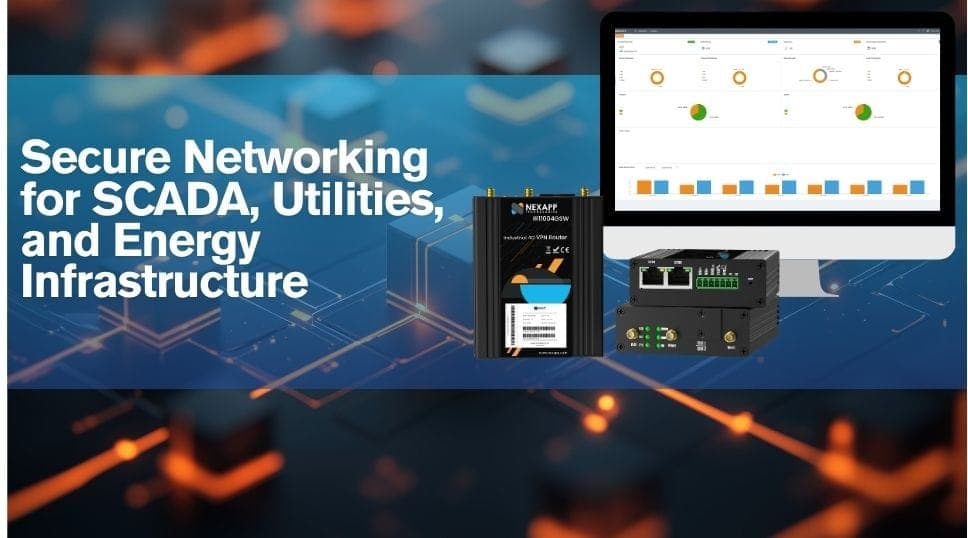
Secure SCADA Networking with a 4G/5G IoT Gateway | Nexapp
How an industrial 4G/5G IoT gateway secures SCADA and utility sites: IPsec tunnels, IEC 104, DNP3 and Modbus, OT/IT segmentation and DIN-rail design.
5G and IoT Security Risks and How to Manage Them | Nexapp
The main 5G and IoT security risks are insecure devices, unencrypted traffic, missed updates and weak authentication. Six practical steps reduce each one.
How IIoT Is Changing Industrial Connectivity | Nexapp
IIoT links industrial sensors, machines and cloud platforms. Learn how it changes connectivity needs, what drives adoption and why security matters.
Talk to a Nexapp architect about How to Secure IoT Devices: Key Threats and Fixes | Nexapp
24×7 NOC in Pune · 75,000+ devices deployed · 400+ enterprise and banking customers since 2014.