

Maximizing Benefits From SD-WAN Deployments In Multi-Cloud Environments
Multi-cloud operations, management, and control are complicated and require a well-engineered SD-WAN strategy for the best user experience. The IT industry is experiencing a significant transformation. The unprecedented crisis and remote work environment have led to a greater dependency on clou
Short answer: SD-WAN makes multi-cloud easier to run by sending each application over the best link with application-aware policies, instead of backhauling all traffic through a central site. It also gives one view of every site's traffic and adds encryption and security policies across clouds. Organisations short of multi-cloud skills can use a managed SD-WAN service to speed up the move.
The IT industry is experiencing a significant transformation. Remote and hybrid work have led to a greater dependency on cloud platforms. Cloud computing’s underlying benefits are longstanding, such as agility, scalability, innovation, and affordability. All the same, given the scale and nimbleness with which information goes through multiple applications these days, enterprises don’t want to risk their business continuity by relying on a stand-alone cloud service provider.
Many companies now turn to a multi-cloud environment, for example, by using two or more Infrastructure as a Service (IaaS) platforms. This approach leads to a more coherent experience, provides flexibility, savings, and optimizes various applications’ workloads. Besides, multi-cloud platforms also help companies expand global cloud coverage, get custom support for specific applications, reduces downtime risks, avoid vendor lock-in, and use the best-suited service for each workload.
Despite these innumerable benefits, the multi-cloud ecosystem’s management and control are challenging and need a well-crafted strategy. Every cloud environment is unique and requires different ways of working with transparency. As a result, it may be difficult for organizations to operate among diverse cloud-based ecosystems efficiently.
The problem can be further compounded because most IT departments do not possess the necessary skills or expertise to do multi-cloud environments. The skills required to manage the multi-cloud environment are remarkably different from those that IT teams have to manage on-site domains. It is impractical to self-manage such a critical transformation activity in-house without the required IT know-how.
In this challenging situation, businesses can consider the option of a managed SD-WAN service to accelerate their transition to a multi-cloud environment.
How does SD-WAN help multi-cloud?
Establish secure and high-performance connectivity: For any organization, the adoption of a multi-cloud approach requires a thorough assessment. In a multi-cloud architecture, enterprises should iron out flaws related to data protection, security, and application performance.
Application-aware strategies: The conventional WAN methodology of backhaul of traffic on dedicated circuits to a central broadband access point has become less relevant in the cloud age. The SD-WAN can solve cross-cloud connectivity access by defining specific application-aware strategies and traffic priorities to connect users to the various cloud platforms.
For example, in a multi-cloud environment, SD-WAN can help prioritise video conferencing over an intranet portal access to ensure no lag time during the conference call because it could be a critical meeting in real-time.
Simplifies WAN: With SD-WAN, organizations can streamline their WAN infrastructure and minimise connectivity costs. It allows companies to use the most optimised links for various applications and workloads, resulting in bandwidth’s optimum utilisation. SD-WAN platforms can comprehend network traffic and deploy customised management and security policies based on users’ specific needs, devices, or applications to achieve a better user experience.
Enhance network visibility: SD-WAN technology also provides IT, administrators, with every site’s network visibility through a centralized channel. The technology provides enhanced visibility, both from the perspective of applications as well as devices. One can monitor traffic for irregularities and obtain qualitative information around applications that need more bandwidth and those that do not operate according to expectations. Note that the lack of visibility of the number of applications and their bandwidth consumption modes can also make systems vulnerable and susceptible to attacks.
Heightened security: The greater visibility of the devices allows IT departments to implement specific security policies. SD-WAN empowers developers to leverage dependable APIs to reinforce network security protocols and streamline application lifecycle management. This information, along with appropriate analysis and automation processes, prevents the risk of undesirable latency, which stimulates the end-user experience. Many SD-WAN service providers offer data traffic encryption, contextual awareness capabilities, and virtual private networks that act like an added layer to secure the multi-cloud environment.
What should you ask before adopting SD-WAN for multi-cloud?
Some of the key questions that organizations must deliberate before adopting the SD-WAN approach for multi-cloud environments are:
- What types of cloud platforms do you need to access?
- Are they aligned with your business goals?
- Where are your cloud solutions hosted?
- How many sites/branch locations does your company have?
- Have you identified critical cloud-based apps that are critical to your enterprise?
- What are your future IT requirements?
Never forget that each organization has a different network and cloud ecosystem. A knowledgeable partner can help you assess your exact needs and get the most from multi-cloud environments.
Related: Nexapp SD-WAN Enterprise with application-aware steering, managed SD-WAN and 24×7 NOC services and SASE vs SD-WAN vs SSE for Indian firms.
Frequently asked questions
Why use SD-WAN in a multi-cloud environment?
Traditional WANs backhaul traffic to a central site, which adds delay for cloud apps. SD-WAN connects users directly to each cloud platform and uses application-aware policies to give critical apps priority.
What is application-aware routing in SD-WAN?
Application-aware routing identifies each application and sends it over the link that suits it best, with set traffic priorities. For example, a live video call can be prioritised over intranet browsing so the call does not lag.
What should I check before adopting SD-WAN for multi-cloud?
Decide which cloud platforms you need, where they are hosted, how many sites you have, which cloud apps are business-critical and what your future IT requirements are.
Is managed SD-WAN a good option for multi-cloud?
Yes, if your IT team lacks multi-cloud skills. A managed service handles design and day-to-day operations; Nexapp, for example, offers managed SD-WAN and SASE run from its 24×7 NOC in Pune.
To get the most out of SD-WAN technology for your company, book a demo with Nexapp.
Related guides
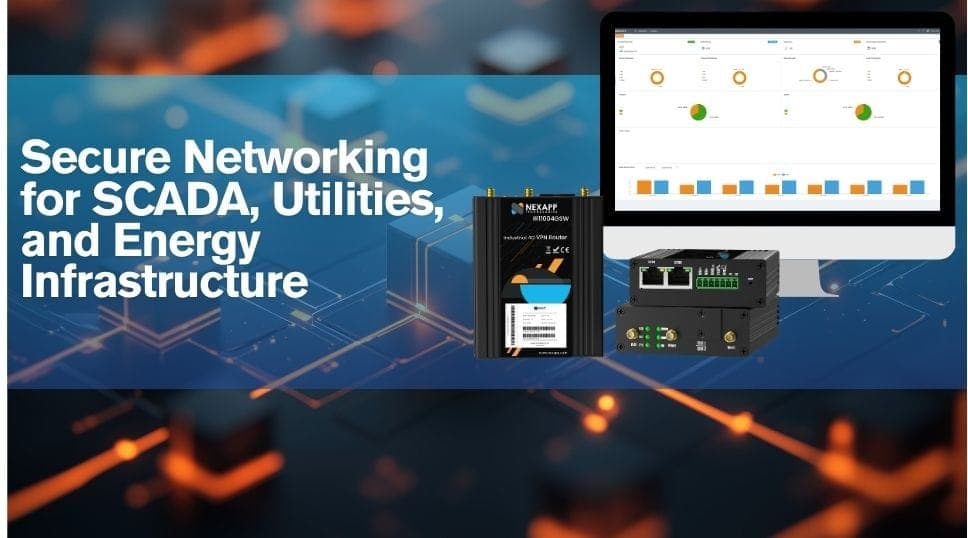
Secure SCADA Networking with a 4G/5G IoT Gateway | Nexapp
How an industrial 4G/5G IoT gateway secures SCADA and utility sites: IPsec tunnels, IEC 104, DNP3 and Modbus, OT/IT segmentation and DIN-rail design.

5G and IoT Security Risks and How to Manage Them | Nexapp
The main 5G and IoT security risks are insecure devices, unencrypted traffic, missed updates and weak authentication. Six practical steps reduce each one.

How IIoT Is Changing Industrial Connectivity | Nexapp
IIoT links industrial sensors, machines and cloud platforms. Learn how it changes connectivity needs, what drives adoption and why security matters.
Talk to a Nexapp architect about SD-WAN for Multi-Cloud: Benefits and Key Questions | Nexapp
24×7 NOC in Pune · 75,000+ devices deployed · 400+ enterprise and banking customers since 2014.