

Are IoT Gateways and Routers the same thing?
In the networking sector, we have come across times when we are not sure about the exact usage of different industrial equipments. Many such equipments may seem to come across to have similar functions, but they may have different functions. One such incident always occurs between understanding
Short answer: No, they are not the same. An industrial router connects equipment and sites to the network and secures the data it carries, often over 4G with automatic failover for business continuity. An industrial IoT gateway works on the data itself: a transparent gateway converts serial-port data into IP data, while an edge computing gateway also processes data as it transmits it, for real-time response.
In practice many industrial devices do both jobs. Nexapp's Instaroute routers, for example, route and secure traffic over 4G/5G and also speak industrial protocols such as Modbus, DNP3, IEC 60870-5-101/104 and MQTT.
| Industrial router | Industrial IoT gateway | |
|---|---|---|
| Main job | Connects equipment and sites to the network | Handles and converts the data itself |
| Data handling | Carries data securely | A transparent gateway converts serial-port data to IP; an edge computing gateway processes data while transmitting it |
| Security | Network security functions; secures business data in transit | Depends on the model |
| Connectivity | 4G cellular for quick access, with automatic failover for business continuity | Agile connection with real-time response at the edge |
| Typical use | An always-on, secure WAN link for a site | Serial and industrial devices, and processing at the edge |
In the networking sector, we have come across times when we are not sure about the exact usage of different industrial equipments.
Many such equipments may seem to come across to have similar functions, but they may have different functions.
One such incident always occurs between understanding the exact functioning of industrial routers and industrial gateways.
What is the difference between an IoT gateway and a router?
Routers: Routers help in data transmission by connecting mechanical equipment to the network.
Routers: Provides various ways to network and network security functions.
Routers: Solves issues regarding data transmission security along with making sure the business data is secure
Routers: Can be used with the help of 4G cellular network, which helps access the network quickly and conveniently. Automatic failover helps with business continuity.
Gateways: There are two types of industrial gateways: transparent transmission gateways and cloud or edge computing gateways.
Gateways: Transparent gateways convert serial port data into IP data, focusing on convenient and fast information transmission.
Gateways: Edge computing gateways process data while transmitting data.
Gateways: Data optimization is at the edge of the internet of things and provides real-time response and agile connection.
Related: industrial 4G router buying guide for India, IoT and M2M connectivity for PLCs, meters and cameras and Instaroute industrial router models.
Frequently asked questions
What is the difference between an IoT gateway and a router?
A router's main job is connecting devices and sites to the network securely and keeping that connection up. A gateway's main job is handling the data: converting serial data to IP, or processing data at the edge before sending it on.
Can a router act as an IoT gateway?
Yes, many industrial routers include gateway functions. Nexapp's Instaroute routers route and secure traffic over 4G/5G and also support industrial protocols such as Modbus, DNP3, IEC 60870-5-101/104 and MQTT, so one device can do both jobs.
What are the two types of industrial IoT gateways?
Transparent transmission gateways convert serial-port data into IP data for fast, simple transmission. Edge computing (or cloud) gateways also process data while transmitting it, which gives real-time response at the edge.
Do I need a gateway or a router for my IoT project?
Choose a router when the priority is secure, always-on connectivity, for example over 4G with automatic failover. Choose a gateway, or a router with gateway features, when devices speak serial or industrial protocols or when data should be processed at the edge.
Why do industrial routers use 4G?
A 4G cellular link lets a site get online quickly without laying cables, and a second link or SIM can take over automatically if the first fails. This supports business continuity at remote or unmanned sites.
To find out more, see Nexapp’s IoT and M2M solutions.
Related guides
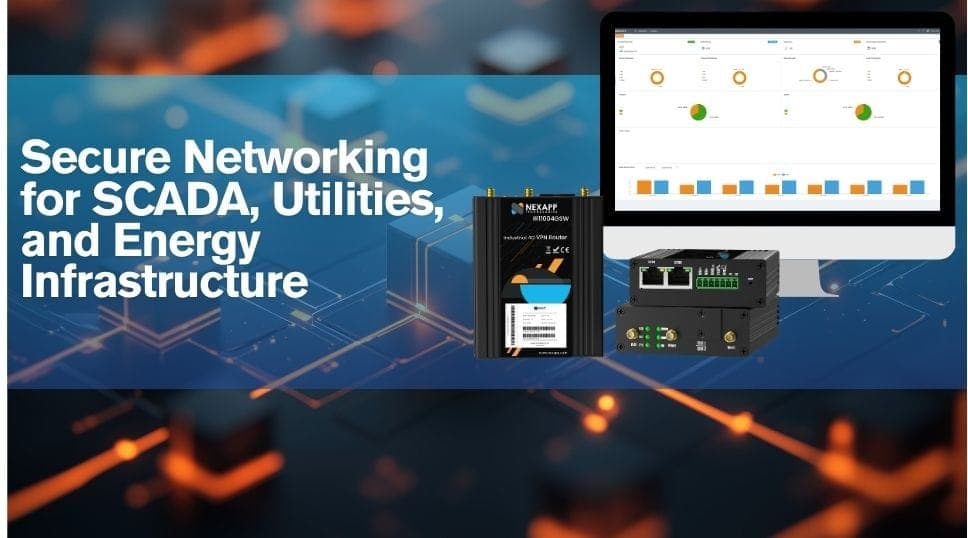
Secure SCADA Networking with a 4G/5G IoT Gateway | Nexapp
How an industrial 4G/5G IoT gateway secures SCADA and utility sites: IPsec tunnels, IEC 104, DNP3 and Modbus, OT/IT segmentation and DIN-rail design.

How IIoT Is Changing Industrial Connectivity | Nexapp
IIoT links industrial sensors, machines and cloud platforms. Learn how it changes connectivity needs, what drives adoption and why security matters.
How to Choose IoT Connectivity: 5 Checks | Nexapp
How to choose IoT connectivity: check hardware reliability, auto-reboot, automatic failover, remote management and built-in firewall and VPN before buying.
Talk to a Nexapp architect about IoT Gateway vs Router: What's the Difference? | Nexapp
24×7 NOC in Pune · 75,000+ devices deployed · 400+ enterprise and banking customers since 2014.