

Store connectivity for POS, payments, guest Wi-Fi and in-store sensors
A store network has to keep billing and payments online, give shoppers Wi-Fi and connect cameras and people-counting sensors, without letting any of them reach the others. Nexapp puts an Instaroute router in each store with a 4G or 5G path, on two operators where needed, that takes over on health checks when the fixed line fails, InstaWave guest Wi-Fi on its own network, and POS, cameras and sensors in separate firewall zones. New stores come online zero-touch and every store is managed from one console.
By Pradeep Tomar, Founder and CEO. Published , last reviewed .At a glance
- Industry
- Retail chains, QSR and franchise stores
- Sites
- Stores, outlets and mall counters
- Devices
- POS, payment terminals, guest Wi-Fi, footfall sensors, CCTV
- Routers
- IR11004GSW, IR11004GDW, IRX100-5G
How does the network connect?
Site equipment connects to an Instaroute IR11004GSW, which carries the traffic over Fixed line (primary) and 4G/5G backup inside a quantum-safe tunnel to Head office and payment systems and Cloud POS and analytics. Nothing on site accepts inbound connections.
What problem does it solve?
When the fixed line drops in the middle of a sale, billing stops, card and UPI payments fail and queues build. Most stores have nobody on site who can diagnose a link.
Stores also carry shoppers' phones on guest Wi-Fi, CCTV, people-counting sensors and back-office PCs. On one flat network, a compromised camera or guest device can reach the POS, and card-data security programmes expect payment systems to be kept apart.
Chains open stores to a date, often many at once, and franchise networks add owners who should see their own stores but not change security policy.
How does Nexapp solve it?
Keep store POS and payments running on 4G/5G failover, run InstaWave guest Wi-Fi, and connect footfall sensors and cameras in separate zones, from one console.
Payments that survive a line cut
A 4G or 5G path backs up the fixed line: health checks move billing and payment traffic to cellular when the line fails, and dual-SIM arbitration chooses between two operators on dual-SIM models. The dual-module IR11004GDW keeps two operators live at once.
POS, cameras, sensors and guests kept apart
Zone firewall and VRF segmentation put POS, CCTV, footfall sensors, back office and guest Wi-Fi in separate zones, with SPI and DoS protection on the router.
Guest Wi-Fi with InstaWave
InstaWave gives shoppers internet access through a captive portal on its own SSID and VLAN. Adaptive QoS keeps billing ahead of guest traffic, music streaming and updates.
Stores open zero-touch
Store templates (small, standard, flagship) carry WAN, SIM policy, VLANs, firewall and Wi-Fi settings. Pre-register devices by serial number and each store comes online when the device is powered on.
One console for every site
Instaroute SDWAN Lite 2.0 shows the health, signal and data usage of every router, with zero-touch set-up and canary firmware rollout, for up to 100,000 devices per deployment. Run it Nexapp-hosted in India or self-hosted.
How is the site secured in the AI era?
Security is a requirement, not an add-on. AI helps attackers find exposed devices and weak access faster than ever, so this design exposes nothing, encrypts every link and checks every person who connects.
Nothing exposed to the internet
The router opens only outbound, encrypted connections. Equipment on site has no public IP and accepts no inbound connections, so automated scanners have nothing to find. Zero trust access
Quantum-safe encryption on every link
Traffic travels in IPsec IKEv2 tunnels with hybrid ML-KEM key exchange, so data captured today cannot be decrypted later. Post-quantum cryptography
Zones, not one flat network
Each group of equipment on site gets its own zone behind the zone firewall, so one compromised device cannot reach the rest. IoT and OT security
Access for people, not networks
Engineers and vendors connect through InstaAccess to the named equipment they support, and every session is logged. SSE and ZTNA
Signed, staged firmware
Instaroute SDWAN Lite 2.0 rolls out post-quantum-signed firmware to a canary group first, with rollback, so a bad update never reaches every site at once. Instaroute SDWAN Lite 2.0
AI that waits for your approval
NexParth AI spots problems and proposes the fix, and nothing changes until a person approves it. NexParth AI
What does the SDWAN Lite dashboard show?
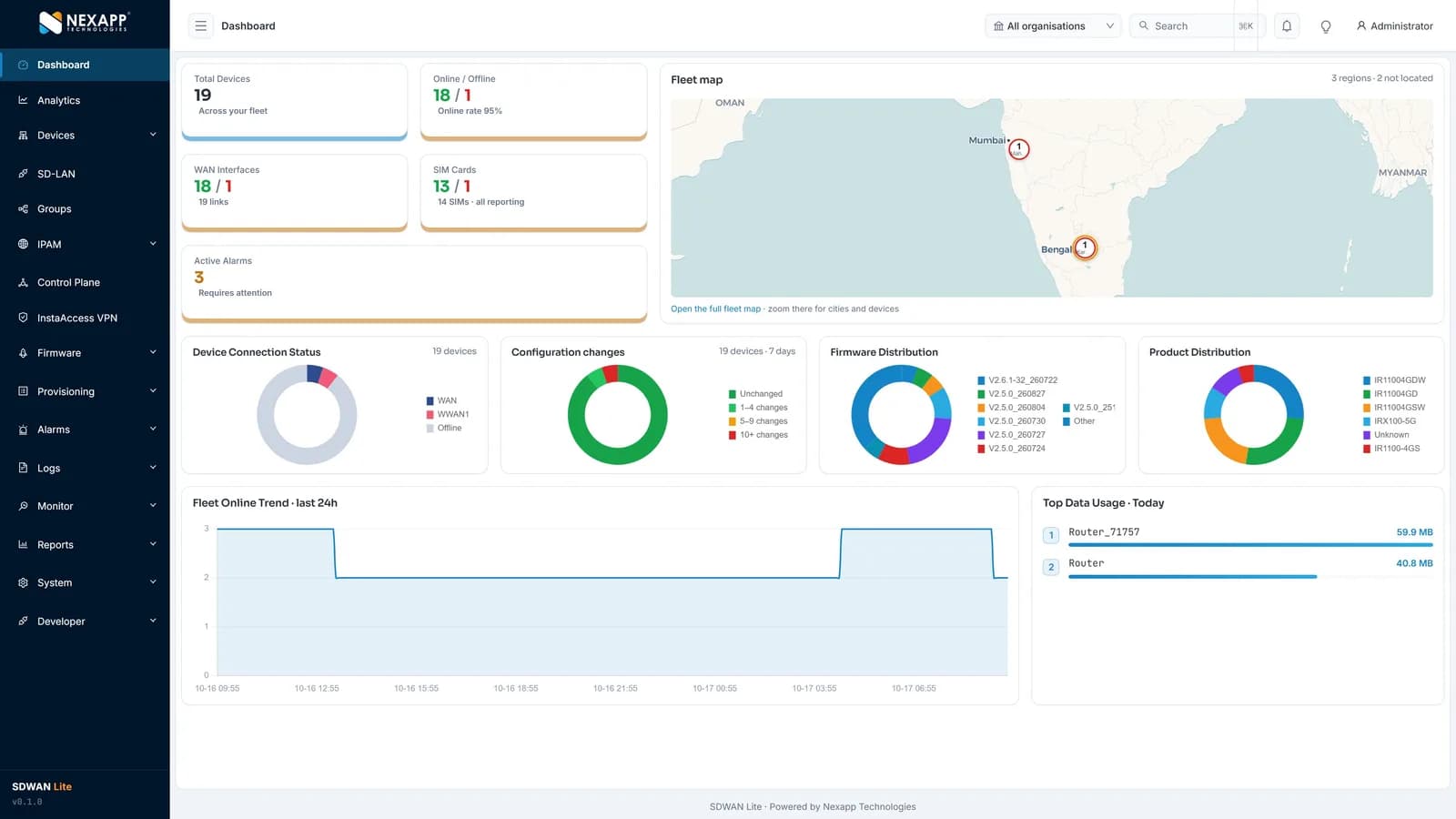
One screen shows the whole fleet: total devices and online rate, WAN links and SIM cards, active alarms, a fleet map, firmware versions, configuration changes, product mix and data usage. Instaroute SDWAN Lite 2.0 manages up to 100,000 routers per deployment, hosted by Nexapp in India or self-hosted.
How is it deployed?
A typical rollout takes 5 steps, and routers configure themselves when they are powered on at site.
Template
Define store profiles (small, standard, flagship) with WAN, SIM policy, VLANs, firewall and Wi-Fi settings.
Pre-register
Upload device serial numbers against store IDs.
Ship and plug in
The store connects power, the fixed line and SIMs, and the device comes online zero-touch.
Verify
The 24×7 NOC in Pune confirms links, POS reachability and failover; field teams handle any site issue.
Operate
Alarms for link state, signal and data usage, with one policy pushed to every store.
What does the specification ask for, and how does Nexapp meet it?
These are the requirements buyers and tenders usually set for this application, and the Nexapp capability that meets each one today.
| Requirement | How Nexapp meets it |
|---|---|
| POS and payments online when the fixed line fails | Link backup on health checks; dual-SIM 4G/5G with arbitration by signal, latency or data usage |
| Payment traffic prioritised | Adaptive QoS; two links active on the dual-module IR11004GDW |
| Payment systems separated from guest and IoT devices | Zone firewall and VRF segmentation in every store |
| Guest Wi-Fi with sign-in | InstaWave captive portal on a guest SSID and VLAN with QoS |
| Threat protection at each store | Zone firewall, SPI and DoS protection and domain filtering on the router |
| Fast rollout with no IT staff on site | Zero-touch provisioning with store templates |
| Central control across franchise stores | Multi-tenant console with one security policy |
Which Instaroute router should you use?
For most sites, use the IR11004GSW. 4G with five ports and 2.4 GHz Wi-Fi: POS, a sensor and guest Wi-Fi from one box in a small store.
IR11004GSW
4G with five ports and 2.4 GHz Wi-Fi: POS, a sensor and guest Wi-Fi from one box in a small store.
- Cellular
- 4G LTE Cat 4 or Cat 6
- SIM slots
- 1
- RS232 / RS485
- RS232 and RS485
- Mounting
- Desktop or wall
IR11004GDW
Dual module keeps two operators live at once, for stores that bill over cellular or cannot wait for a SIM switch.
- Cellular
- 4G LTE Cat 4 or Cat 6
- SIM slots
- 2
- RS232 / RS485
- RS232 and RS485
- Mounting
- Desktop or wall
IRX100-5G
5G, Gigabit Ethernet and Wi-Fi 6 for busy and flagship stores with many cameras and shoppers.
- Cellular
- 5G SA/NSA, sub-6 GHz
- SIM slots
- 2
- RS232 / RS485
- RS232 and RS485 (up to 3 ports)
- Mounting
- Desktop or wall
Also used: Instaroute SDWAN Lite 2.0 · Enterprise Wi-Fi
What are the benefits?
- Billing and payments keep running when the fixed line fails.
- Shoppers get Wi-Fi that never touches store systems.
- Cameras and footfall sensors connect without putting the POS at risk.
- New stores come online at power-on, without an engineer on site.
- One security policy for every store, including franchise outlets.
- Payment and customer data travel in quantum-safe tunnels.
Why choose Nexapp?
- Indian OEM in Pune since 2014, with its own NexappOS and controller
- Class-I local supplier under the PPP-MII Order
- TEC MTCTE certificate 244903206 for nine Instaroute models
- Quantum-safe on every connection: hybrid ML-KEM and ML-DSA
- 24×7 NOC in Pune; hosted in India or self-hosted
- 75,000+ devices deployed for 400+ enterprise and banking customers
Frequently asked questions
Can 4G keep POS running when the store's fixed line fails?
Yes. Instaroute routers carry 4G or 5G, with two operators on dual-SIM models, and health checks move payment traffic to the cellular link when the fixed line fails.
Can POS, CCTV, footfall sensors and guest Wi-Fi share one router?
Yes, in separate zones. Zone firewall and VRF segmentation keep each type of traffic apart, so guest or IoT devices cannot reach the POS.
Does segmentation help with card-data security audits?
Yes, it helps. Keeping payment systems in their own zone limits which systems handle card data, which narrows what a card-data security audit has to cover. Compliance itself stays with the retailer and is assessed separately.
How does guest Wi-Fi work in the store?
InstaWave provides hotspot and guest Wi-Fi with a captive portal, on its own SSID and VLAN with QoS. Guest Wi-Fi collects personal data such as mobile numbers, so it falls under the DPDP Act, whose substantive duties apply from about May 2027.
How fast can a chain roll out new stores?
Zero-touch provisioning removes on-site configuration, so the pace depends on logistics and link delivery rather than engineers.
Can franchise owners see their own stores?
Yes. The multi-tenant console can give franchise partners visibility of their own stores while security policy stays under central control.
Read next
Planning a similar deployment?
Tell us your sites, devices and links, and a Nexapp engineer will recommend the routers and design.
Related use cases
Retail
4G router for self-service kiosks, vending machines and parcel lockersIndustrial 4G routers for self-service kiosks, vending machines and parcel lockers: dual-SIM, serial ports, no public IP needed and one console for the fleet.
Retail
4G/5G router for digital signage and remote content updates4G and 5G routers for digital signage in stores, malls and transit: content updates over cellular, dual-SIM, media players kept off the internet, one console.