

Transport and logisticsSDWAN Lite
Bus Wi-Fi, CCTV and ticketing connectivity for city and intercity buses
A bus needs one managed connection for passenger Wi-Fi, onboard CCTV, ticketing machines and passenger information displays. An Instaroute 4G or 5G router on board gives passengers Wi-Fi through the InstaWave captive portal, keeps cameras, the mobile NVR and ticketing in separate segments, and lets the control room reach live view through an encrypted tunnel with no public IP on the SIM. Every bus in the fleet is set up zero-touch and managed from one console.
By Pradeep Tomar, Founder and CEO. Published , last reviewed .At a glance
- Industry
- City bus, intercity coach, staff and school transport
- Devices
- Passenger Wi-Fi, CCTV and mobile NVR, ticketing, PIS displays
- Links
- Dual-SIM 4G or 5G, two operators
- Routers
- IR11004GD, IRX100-5G, IR1180DM
How does the network connect?
Site equipment connects to an Instaroute IR11004GD, which carries the traffic over SIM 1 · Operator A and SIM 2 · Operator B inside a quantum-safe tunnel to Transport control room and Depot and fleet console. Nothing on site accepts inbound connections.
What problem does it solve?
A modern bus carries cameras, a mobile NVR, electronic ticketing machines, passenger information displays and often passenger Wi-Fi. Each system tends to arrive with its own SIM or modem, and nobody at the depot can see which ones are actually online.
When the control room needs to see a camera after an incident, the bus is on the road behind a mobile SIM with no public IP, so port forwarding to the NVR does not work and a visit to the depot is the usual answer.
Passenger phones and vehicle systems on one flat network put ticketing and cameras within reach of anyone who joins the Wi-Fi, and one operator's coverage gap takes every system offline at once.
How does Nexapp solve it?
In-bus 4G/5G routers for passenger Wi-Fi with InstaWave, onboard CCTV and mobile NVR viewing without a public IP, ticketing and PIS, from one console.
Passenger Wi-Fi with InstaWave
Passengers sign in through the InstaWave captive portal on a guest network of their own, with per-SSID isolation so phones cannot see each other. IRX100 5G models have dual-band Wi-Fi 6; most IR1100 4G models have 2.4 GHz Wi-Fi.
Live view without a public IP
Cameras record to the onboard NVR, and the control room reaches live view or recordings through an encrypted tunnel or SD-LAN, with no port open to the internet and no public IP on the SIM.
Passengers never reach vehicle systems
Passenger Wi-Fi, CCTV, ticketing and displays each get their own VLAN or SSID, kept apart by zone firewall rules, with QoS so passenger traffic cannot crowd out operations.
Two operators on the move
Dual-SIM arbitration switches operator by signal, latency or data usage as the vehicle crosses coverage gaps, so onboard systems keep a link on highways, in ghats and between towns.
Every vehicle in one console
Instaroute SDWAN Lite 2.0 shows signal, data usage and health for every vehicle, applies one template with zero-touch set-up and rolls out signed firmware with canary rollout and rollback. Management works on SIMs with no public IP.
How is the site secured in the AI era?
Security is a requirement, not an add-on. AI helps attackers find exposed devices and weak access faster than ever, so this design exposes nothing, encrypts every link and checks every person who connects.
Nothing exposed to the internet
The router opens only outbound, encrypted connections. Equipment on site has no public IP and accepts no inbound connections, so automated scanners have nothing to find. Zero trust access
Quantum-safe encryption on every link
Traffic travels in IPsec IKEv2 tunnels with hybrid ML-KEM key exchange, so data captured today cannot be decrypted later. Post-quantum cryptography
Zones, not one flat network
Each group of equipment on site gets its own zone behind the zone firewall, so one compromised device cannot reach the rest. IoT and OT security
Access for people, not networks
Engineers and vendors connect through InstaAccess to the named equipment they support, and every session is logged. SSE and ZTNA
Signed, staged firmware
Instaroute SDWAN Lite 2.0 rolls out post-quantum-signed firmware to a canary group first, with rollback, so a bad update never reaches every site at once. Instaroute SDWAN Lite 2.0
AI that waits for your approval
NexParth AI spots problems and proposes the fix, and nothing changes until a person approves it. NexParth AI
What does the SDWAN Lite dashboard show?
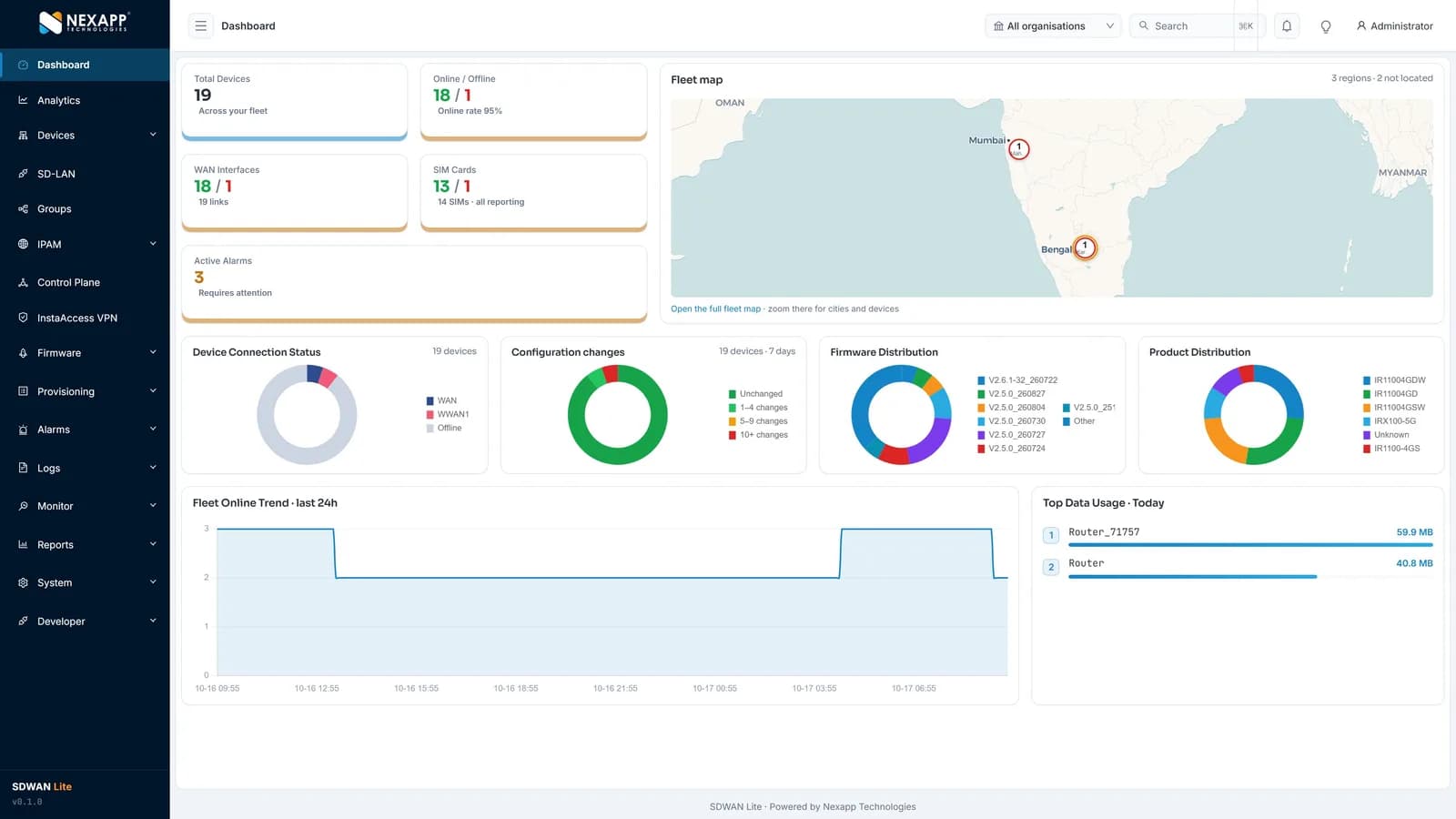
One screen shows the whole fleet: total devices and online rate, WAN links and SIM cards, active alarms, a fleet map, firmware versions, configuration changes, product mix and data usage. Instaroute SDWAN Lite 2.0 manages up to 100,000 routers per deployment, hosted by Nexapp in India or self-hosted.
How is it deployed?
A typical rollout takes 5 steps, and routers configure themselves when they are powered on at site.
List the onboard systems
Record the cameras and mobile NVR, ticketing machines, PIS displays and passenger Wi-Fi on each bus type, and where each one's data must go.
Plan the install
Choose a model per bus type. Nexapp provides mounting, power input and operating temperature details for each install.
Design the segments
Give passengers, CCTV, ticketing and displays their own SSID or VLAN and firewall rules, with InstaWave on the passenger network.
Fit and power on
Insert two SIMs and power on. Each router is recognised by its serial number and pulls the bus template.
Run the fleet
Signal, data usage and health for every bus in one console, with alarms and canary firmware rollout, backed by the 24×7 NOC in Pune.
What does the specification ask for, and how does Nexapp meet it?
These are the requirements buyers and tenders usually set for this application, and the Nexapp capability that meets each one today.
| Requirement | How Nexapp meets it |
|---|---|
| Passenger Wi-Fi with sign-in | InstaWave captive portal on a guest SSID with per-SSID isolation |
| View CCTV from the control room | Encrypted tunnels and SD-LAN; no public IP on the SIM |
| Keep passengers away from vehicle systems | VLANs, SSIDs and zone firewall rules |
| Stay online through coverage gaps | Dual-SIM arbitration by signal, latency or data usage |
| Bus location | GPS on the IR1180DM |
| Control data costs | Per-SIM data tracking with alarms; SIM switching by data usage |
Which Instaroute router should you use?
For most sites, use the IR11004GD. The standard bus choice: dual-SIM 4G, five Ethernet ports for the NVR and ticketing, and 2.4 GHz Wi-Fi.
IR11004GD
The standard bus choice: dual-SIM 4G, five Ethernet ports for the NVR and ticketing, and 2.4 GHz Wi-Fi.
- Cellular
- 4G LTE Cat 4 or Cat 6
- SIM slots
- 2
- RS232 / RS485
- RS232 and RS485
- Mounting
- Desktop or wall
IRX100-5G
5G with Gigabit ports and dual-band Wi-Fi 6 for busy routes where several cameras and many passengers share the uplink.
- Cellular
- 5G SA/NSA, sub-6 GHz
- SIM slots
- 2
- RS232 / RS485
- RS232 and RS485 (up to 3 ports)
- Mounting
- Desktop or wall
IR1180DM
DIN-rail 4G with dual SIM, five ports, 2.4 GHz Wi-Fi and GPS for location data.
- Cellular
- 4G LTE Cat 4 or Cat 6
- SIM slots
- 2
- RS232 / RS485
- RS232 and RS485
- Mounting
- DIN-rail
Also used: Enterprise Wi-Fi · Instaroute SDWAN Lite 2.0 · InstaAccess client (ZTNA, SSL VPN, IPsec VPN)
What are the benefits?
- One managed connection replaces separate SIMs in the NVR, ticketing and displays.
- The control room views onboard cameras without exposing them to the internet.
- Passengers sign in through InstaWave and never share a network with vehicle systems.
- Two operators keep the bus online through coverage gaps on the route.
- Every bus in the fleet uses one template and comes online zero-touch.
- Per-SIM data tracking and alarms keep passenger Wi-Fi and uploads within the plan.
Why choose Nexapp?
- Indian OEM in Pune since 2014, with its own NexappOS and controller
- Class-I local supplier under the PPP-MII Order
- TEC MTCTE certificate 244903206 for nine Instaroute models
- Quantum-safe on every connection: hybrid ML-KEM and ML-DSA
- 24×7 NOC in Pune; hosted in India or self-hosted
- 75,000+ devices deployed for 400+ enterprise and banking customers
Frequently asked questions
Which router is best for bus Wi-Fi?
For most buses, the IR11004GD: dual-SIM 4G, five Ethernet ports and 2.4 GHz Wi-Fi, with InstaWave for passenger sign-in. On busy routes, the IRX100-5G adds 5G and dual-band Wi-Fi 6. Choose the IR1180DM where the bus needs GPS location.
Can the control room view bus CCTV without a static IP?
Yes. The router builds an encrypted tunnel out to the control room, so live view and recordings on the mobile NVR are reachable even though the SIM sits behind carrier-grade NAT.
Do passengers get a sign-in page?
Yes. InstaWave signs passengers in through a captive portal on a separate guest network, kept apart from cameras, ticketing and displays.
Can the depot see where each bus is from the router?
Only with the IR1180DM, the Instaroute model with GPS, which adds location data and location-aware alarms next to link health. On other models, location comes from the bus's own telematics unit.
Can the router power the cameras?
No. Power cameras from the bus's own PoE switch or supply; the router's Ethernet ports carry data.
Is the router approved for vehicle installation?
Instaroute routers support in-vehicle use. Mounting, power input and operating temperature details for each model are provided by Nexapp for each install.
Read next
Planning a similar deployment?
Tell us your sites, devices and links, and a Nexapp engineer will recommend the routers and design.
Related use cases
Transport and logistics
Warehouse Wi-Fi and connectivity for scanners, AGVs and the WMSWarehouse networks for handheld scanners, AGVs, AMRs and the WMS: Wi-Fi 6 at the edge, separate device segments, and fibre plus 5G links to the data centre.
Transport and logistics
Connectivity for cold rooms and cold-storage temperature monitoring4G routers that carry cold-room and chiller readings over Modbus, serial or MQTT to your platform, on two operators, with alarms when a site goes quiet.
Transport and logistics
Connectivity for ports, container terminals and gate automation4G and 5G links for container yards, gates and crane controllers: IP65 outdoor units, gate OCR cameras on 5G, PLC data over Modbus, segmented zones.