

What is SD-WAN? Full form, meaning and how it works
The SD-WAN full form is software-defined wide area network. It connects branches, data centres and clouds over any mix of links, such as MPLS, leased line, broadband and 4G/5G, and lets a central controller decide which link each application should use. Edge devices at each site build encrypted tunnels over every link, measure their quality all the time and move traffic automatically when a link degrades. The result is a WAN that is cheaper to run, more resilient and managed from one console instead of box by box.
Key facts
| Full form | Software-defined wide area network |
| Simple meaning | Software that runs all of a site's network links as one, and picks the best link for each application |
| Main parts | Edge device at each site, a central controller, and an encrypted overlay of tunnels |
| Links it uses | Any mix: MPLS, internet leased line (ILL), broadband, 4G/5G and others |
| What it replaces | Box-by-box router and VPN configuration, and much of a branch's reliance on MPLS |
| Where it fits in SASE | SD-WAN is the networking half; SSE (ZTNA, SWG, CASB, DLP, FWaaS) is the security half |
SD-WAN full form and meaning
SD-WAN full form: software-defined wide area network.
Each part of the name tells you something:
- Wide area network (WAN) is the network that links an organisation's sites: branches, offices, plants, ATMs, data centres and clouds. Unlike a local network inside one building, a WAN runs over links bought from telecom operators.
- Software-defined means the WAN is controlled by software from a central point. You describe what you want, such as "send payment traffic over the best link and keep video off 4G", and the software configures every site to do it.
In simple words, SD-WAN is a smarter way to run branch connectivity. Instead of one router per site with one main link and a manual backup, SD-WAN treats every link at a site as part of one pool. It watches how each link is performing and sends each application where it will work best.
The full forms of related terms, such as SASE, SSE, ZTNA and NGFW, are in our networking and security glossary.
Why SD-WAN exists
Traditional WANs were built when most applications ran in the head office data centre. Branches connected over private MPLS circuits, and internet traffic was sent back to the data centre to pass through a central firewall.
Three things changed that:
- Applications moved to the cloud. Email, collaboration tools and many business applications now run as SaaS. Backhauling that traffic to the data centre adds delay and wastes MPLS capacity.
- Internet links became cheap and fast. Broadband and 4G/5G now give far more bandwidth per rupee than MPLS. But using them well needs something to manage several links together.
- Networks grew. An organisation with hundreds of branches cannot configure and troubleshoot each router by hand.
SD-WAN answers all three. It uses every link, sends cloud traffic out locally where policy allows, and manages every site from one place.
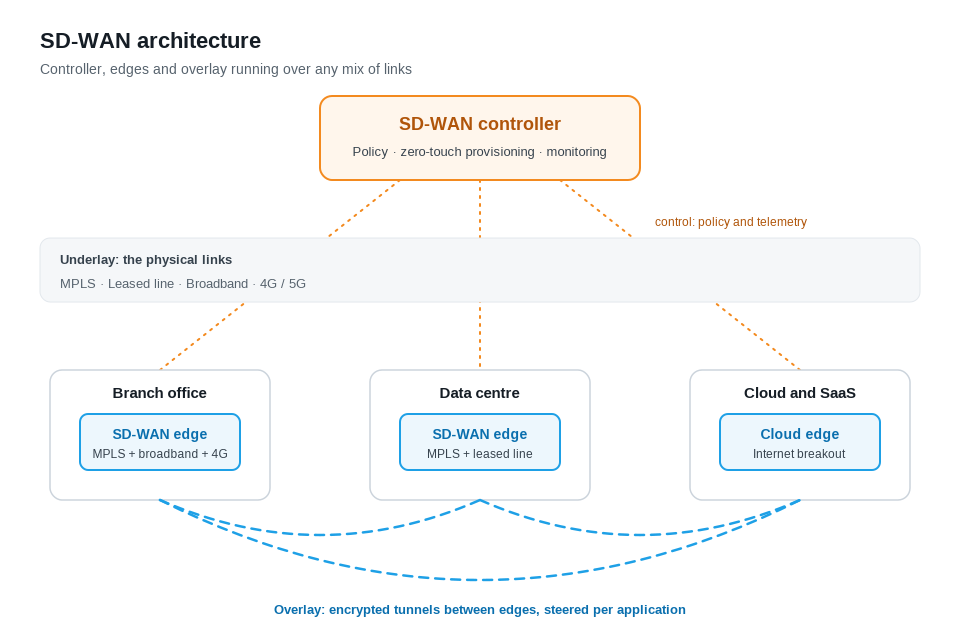
SD-WAN architecture: edge, controller and overlay
Every SD-WAN has three building blocks. This section covers the basics; for the full breakdown of planes, topologies and deployment models, see SD-WAN architecture explained.
1. The SD-WAN edge
The edge is the device at each site. It can be a physical appliance in a branch, a virtual machine in a data centre or a virtual edge in a public cloud. Every WAN link at the site plugs into it. The edge:
- builds encrypted tunnels over each link to other sites and hubs;
- measures loss, latency and jitter on every link, all the time;
- identifies applications, usually with deep packet inspection (DPI);
- forwards each flow over the path that policy chooses;
- on a secured SD-WAN, also inspects traffic with firewall and threat-prevention features.
2. The SD-WAN controller
The controller is the brain. It holds the policy for the whole network and pushes it to every edge. Administrators use it to:
- design the topology: hub-and-spoke, full mesh or partial mesh;
- set application rules and service levels;
- bring new sites online with zero-touch provisioning;
- monitor every link and application from one console;
- upgrade firmware and roll back changes.
The controller can be hosted by the vendor or run in your own data centre. For regulated Indian organisations, where it runs and where its logs live is often the first question in an RFP.
3. The overlay
The overlay is the virtual network the edges build on top of the physical links, which are called the underlay. It is a set of encrypted tunnels, usually IPsec, between sites. Applications see one private network, whatever mix of links sits underneath. If one link fails, the tunnels on the other links carry on.
| Layer | What it is | Example |
|---|---|---|
| Underlay | The physical links from operators | MPLS, ILL, broadband, 4G/5G |
| Overlay | Encrypted tunnels across those links | IPsec tunnels between branch, hub and cloud |
| Control | Central policy and management | The SD-WAN controller |
How SD-WAN works, step by step
- The edge comes online. A new device is plugged in at the branch. It calls home, the controller recognises it, and it receives its configuration. No engineer needs to configure it on site.
- Tunnels are built. The edge builds encrypted tunnels over each available link to hubs and other sites, as the topology defines.
- Links are measured. Probes check every link for loss, latency and jitter, continuously.
- Applications are identified. DPI recognises each flow, for example core banking, UPI, voice, video, SaaS or software updates.
- Traffic is steered. Policy decides the path for each application: the best tunnel, a direct internet breakout, a security gateway, or drop.
- Failover happens automatically. When a link breaches its quality threshold, traffic moves to a healthier link. Critical flows can even be sent over two links at once.
- Everything is logged. Link health, application performance, configuration changes and security events are recorded centrally for operations and audit.
SD-WAN vs MPLS vs VPN
SD-WAN is often compared with MPLS and with VPN. They are not quite the same kind of thing.
| MPLS | Site-to-site VPN | SD-WAN | |
|---|---|---|---|
| What it is | A private WAN service from a telecom operator | An encrypted tunnel between two sites | Central software that runs all of a site's links as one encrypted WAN |
| Links | One operator's private circuits | Usually one internet link | Any mix: MPLS, ILL, broadband, 4G/5G |
| Path choice | Fixed by the operator | Fixed route | Per application, based on live link quality |
| Failover | Depends on the operator and backup design | Manual or slow routing failover | Automatic, driven by link probes |
| Management | Operator-managed, site by site changes | Device by device | One controller for every site |
| Cost driver | Bandwidth on private circuits | Engineer time per site | Licence per site, with cheaper internet bandwidth |
SD-WAN does not have to replace MPLS. Many organisations keep MPLS for some sites or applications and add broadband and 4G/5G alongside it under SD-WAN. Others retire MPLS branch by branch once they have measured the internet links. For a rupee-by-rupee comparison, see SD-WAN vs MPLS in India.
SD-WAN is built on VPN encryption. Its tunnels are usually IPsec, the same technology as a site-to-site VPN. What SD-WAN adds is the control layer on top: many links, live measurement, per-application steering and central management. See SD-WAN vs VPN.
SD-WAN router vs regular router
People often search for an "SD-WAN router". The term usually means an SD-WAN edge device, which looks like a router but behaves differently.
| Regular branch router | SD-WAN edge ("SD-WAN router") | |
|---|---|---|
| Links | One main link, perhaps a backup | Several links used together |
| Decisions | Routes by destination address | Steers by application and live link quality |
| Configuration | Configured locally, device by device | Configured centrally from a controller, zero-touch |
| Failover | Waits for routing to notice a dead link | Moves traffic when quality degrades, before users notice |
| Visibility | Interface counters on the device | Per-link and per-application reports across all sites |
| Security | Basic access lists | On a secured SD-WAN edge: firewall and threat prevention under central policy |
A cellular router with dual SIMs and automatic failover is not the same as a full SD-WAN edge, but the two meet in many networks. A 4G or 5G router is often the second or third link at a branch, or the only link at an ATM, kiosk or remote site.
At Nexapp, Instaroute 4G and 5G routers cover those cellular sites. The Lite Series 4G routers and IRX100 5G routers are managed from Instaroute SDWAN Lite 2.0, a fleet management platform with zero-touch provisioning and flat per-device pricing. Any Enterprise X Series model can also run as an SD-WAN Enterprise edge on the Nexapp Controller.
For what to check before you buy one, see SD-WAN router: what it is and what to check.
Benefits of SD-WAN
- Higher uptime. Several links per site, with automatic failover, mean one link outage no longer takes a branch offline.
- Better application performance. Voice, video and transaction traffic go over the link that suits them, based on live measurements. This is a different approach from WAN optimisation, which compresses and caches data on one link; see WAN optimization vs SD-WAN.
- Lower WAN cost. Broadband and 4G/5G can carry traffic that once needed MPLS, and SaaS traffic can leave locally instead of being backhauled.
- Faster rollout. Zero-touch provisioning brings a new branch up when the box is plugged in.
- Central control. One policy, one console and one set of reports for every site.
- Security built in. A secured SD-WAN edge inspects traffic at the branch, so local internet breakout does not open a gap.
- A path to SASE. SD-WAN is the networking half of SASE. Adding SSE later brings zero trust access and cloud security for users. See SASE vs SD-WAN vs SSE.
SD-WAN has trade-offs too, such as relying on internet links without an end-to-end SLA. See SD-WAN advantages and disadvantages for each one and how to reduce it.
When do you need SD-WAN?
You probably need SD-WAN if several of these are true:
- you have many branches, and each new site adds manual network work;
- sites have, or could have, more than one link;
- applications such as core banking, UPI, point of sale, voice or video need consistent performance;
- you want to reduce MPLS spend without losing reliability;
- staff use SaaS and cloud applications heavily;
- auditors ask for evidence of uptime, configuration changes and security events.
A plain VPN can still be enough for two or three offices on one internet line each, with no applications that need guaranteed performance.
SD-WAN in India
Indian branch networks have their own mix of conditions, and SD-WAN choices here are shaped by them.
- Mixed links. Many networks already run a mix of MPLS, ILL, broadband, RF, VSAT and 4G. SD-WAN lets you keep what works and add capacity, rather than rip anything out.
- Cellular as a real link. 4G and 5G are now often the backup link, and sometimes the main one. Nexapp moved 2,500 ATM sites from VSAT to dual-LTE with day-1 zero-touch provisioning. Read the VSAT to LTE ATM story.
- Logs and data in India. CERT-In requires ICT logs to be kept for 180 days within India and incidents to be reported within 6 hours. Where the controller runs, and where its logs are stored, matters.
- Banking regulation. RBI's Directions of 31 July 2026 set expectations for secure network interconnections and strong cryptography for regulated entities. See RBI cybersecurity Directions 2026.
- Make in India procurement. Government and PSU tenders give preference to Class-I local suppliers under the PPP-MII Order. See Class-I local supplier rules.
For a buyer's checklist, see how to choose an SD-WAN provider in India.
Where Nexapp fits
Nexapp SD-WAN Enterprise is a secured SD-WAN from an Indian OEM in Pune, in production since 2014. The Nexapp Controller builds an encrypted overlay across MPLS, ILL, broadband and 4G/5G, steers each application to the best path and fails over in under a second. You can run the controller in your own data centre and DR site, or use Nexapp-hosted in India.
Each edge carries IPS, gateway antivirus, web filtering, anti-spam and InstaShield IP reputation blocking, and extends to NGFW policy and SSE/ZTNA from the same vendor. Every IKEv2 tunnel uses hybrid post-quantum key exchange (ML-KEM, NIST FIPS 203). See post-quantum cryptography.
For cellular sites such as ATMs, kiosks, CCTV and IoT, Instaroute SDWAN Lite 2.0 manages Instaroute 4G and 5G routers at a flat price per device. Nexapp has deployed 75,000+ devices for 400+ enterprise and banking customers.
Read next: SD-WAN architecture · SD-WAN RFP clauses for Indian banks · ZTNA vs VPN · SD-WAN providers in India
Frequently asked questions
What is the full form of SD-WAN?
SD-WAN stands for software-defined wide area network.
It is a way of running the links between an organisation's sites under central software control.
What is SD-WAN in simple words?
SD-WAN is software that runs all of a site's network links as one.
It measures each link all the time and sends each application over the link that will work best, switching automatically when a link degrades.
What is the difference between SD-WAN and a WAN?
A WAN is the network that links your sites.
SD-WAN is a way of running that WAN: a central controller sets policy, and edge devices use every link at each site together, instead of relying on fixed routes configured box by box.
What are the main components of SD-WAN architecture?
There are three: an edge device at each site, a central controller that holds policy and manages the edges, and an overlay of encrypted tunnels that runs on top of the physical links.
Is SD-WAN a router?
An SD-WAN edge does the job of a branch router and more.
It routes traffic, but it also uses several links together, steers by application and is managed from a central controller. That is why it is often called an SD-WAN router.
Does SD-WAN replace MPLS?
It can, but it does not have to.
Many organisations keep MPLS for some sites and add broadband and 4G/5G under SD-WAN, then retire MPLS branch by branch once they have measured the results.
Is SD-WAN secure?
SD-WAN traffic between sites runs in encrypted tunnels, usually IPsec.
A secured SD-WAN edge also adds firewall and threat prevention at the branch. In Nexapp, every tunnel uses hybrid post-quantum key exchange.
What is the difference between SD-WAN and SASE?
SD-WAN is the networking part: it connects sites and picks the best path.
SASE combines SD-WAN with cloud-delivered security (SSE), such as ZTNA, SWG, CASB and DLP, so users and sites get the same policy wherever they connect.
Planning SD-WAN for your branches? See how it would run across your own links and sites.
24×7 NOC in Pune · 75,000+ devices deployed · 400+ enterprise and banking customers since 2014.